Partial Nephrectomy
Removes the kidney tumour while preserving as much healthy kidney tissue as safely and appropriately possible.
Dr. Nitin Singhal is a surgical oncologist in Ahmedabad providing treatment and surgical management for kidney cancer and other urological cancers.
Patients searching for kidney cancer treatment Ahmedabad or robotic kidney cancer surgery Ahmedabad can undergo an individual evaluation based on tumour size, location, stage, kidney function and overall health.

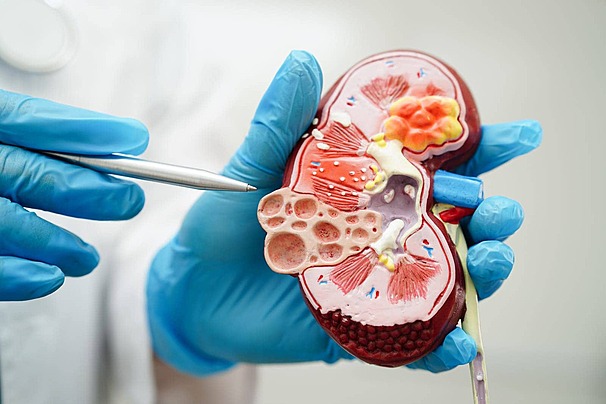
Kidney cancer, also known as renal cancer, begins in the cells of the kidneys – two bean-shaped organs that filter blood, remove waste and help regulate blood pressure.
The most common type in adults is Renal Cell Carcinoma (RCC), while less common forms include Transitional Cell Carcinoma, Wilms’ Tumor and Renal Sarcoma.
Kidney cancer often develops silently and may not cause noticeable symptoms in its early stages. It may sometimes be discovered incidentally during imaging performed for another medical reason.
As the disease progresses, symptoms may include blood in the urine, flank pain, an abdominal or flank lump, unexplained weight loss and fatigue.
Early evaluation can help determine whether a kidney mass requires treatment and whether kidney-preserving surgery may be possible.
Renal Cell Carcinoma is the most common kidney cancer in adults. renal cell carcinoma surgery may involve partial or radical nephrectomy depending on tumour characteristics and the patient's condition.
Kidney cancer treatment depends on the type, stage, location and extent of disease. Surgery remains an important treatment option for many localised kidney cancers.
Removes the kidney tumour while preserving as much healthy kidney tissue as safely and appropriately possible.
Removes the affected kidney and may be considered for selected larger or more complex kidney tumours.
Robotic assistance may be used for selected partial or radical nephrectomy procedures when clinically appropriate.
Selected procedures may be performed through smaller incisions using minimally invasive surgical approaches.
Targeted therapy may be considered for selected patients with advanced kidney cancer according to tumour biology and disease extent.
Immunotherapy may be used for selected advanced kidney cancers to help the immune system recognise and attack cancer cells.
Several lifestyle, medical, family and genetic factors may increase the risk of developing kidney cancer.
Smoking and tobacco exposure are recognised risk factors for kidney cancer.
Obesity and hypertension may increase the likelihood of developing kidney cancer.
Chronic kidney disease and long-term dialysis may be associated with increased kidney cancer risk.
Family history, Von Hippel-Lindau syndrome and certain hereditary renal cancer syndromes may increase risk.
Kidney cancer may not produce obvious symptoms in its early stages. As the disease progresses, some patients may experience:
Visible or unexplained blood in the urine should be medically evaluated.
Ongoing pain in the side or flank may require further assessment.
A persistent lump or swelling should be evaluated to identify its cause.
Unintentional weight loss may be relevant when persistent or accompanied by other symptoms.
Persistent fatigue or appetite changes should be assessed when unexplained.
Fever without an obvious cause may require medical evaluation, particularly when persistent.

Accurate diagnosis and staging help determine the most appropriate treatment approach. Kidney masses may be evaluated using imaging studies to understand their size, location and relationship with surrounding structures.
Tumour size helps determine whether kidney-preserving surgery may be appropriate.
Relationship to blood vessels, the collecting system and healthy kidney tissue influences surgical planning.
Existing kidney function is important when considering kidney-preserving versus kidney-removing surgery.
Cancer stage, other medical conditions and individual surgical risk are considered before treatment.
The stage of kidney cancer helps determine how far the disease has progressed and guides treatment planning.
The tumour is confined to the kidney and is generally smaller in size. Treatment may involve partial or radical nephrectomy depending on the individual case.
The tumour is larger but remains restricted to the kidney without evidence of distant spread. Surgery remains an important treatment option.
Cancer may involve nearby lymph nodes, major blood vessels or surrounding structures. Treatment is planned according to disease extent.
Advanced kidney cancer has spread to distant organs or structures. Treatment may include systemic therapy, immunotherapy and selected surgical approaches.
Treatment is selected according to the tumour, cancer stage, kidney function and patient's overall health.
Partial nephrectomy removes the kidney tumour while preserving as much healthy kidney tissue as possible. A partial nephrectomy robotic approach may be considered for selected patients and tumours.
Radical nephrectomy involves removal of the affected kidney and may be recommended for selected larger or more complex kidney tumours.
Selected kidney cancer procedures can be performed through smaller incisions compared with conventional open surgery.
Targeted medicines may be considered for selected advanced kidney cancers based on disease characteristics.
Immunotherapy may be used for selected patients with advanced kidney cancer.
Advanced kidney cancer may require coordinated care involving surgical oncology, medical oncology, radiology and other specialists.
Robotic-assisted kidney surgery can provide enhanced visualisation and precise instrument control. It can be useful in selected kidney tumour procedures where preserving healthy kidney tissue is important.
For suitable patients, robotic kidney cancer surgery Ahmedabad may involve partial nephrectomy to remove the tumour while preserving functioning kidney tissue.
The decision to use robotic surgery depends on tumour characteristics, anatomy and individual surgical requirements.
Enhanced instrument control can assist during complex surgical movements, while partial nephrectomy may preserve healthy kidney tissue when clinically appropriate.
Dr. Nitin Singhal is an experienced surgical oncologist in Ahmedabad with expertise in complex cancer surgery and robotic surgical techniques.
His kidney cancer approach focuses on accurate assessment, personalised surgical planning and preservation of healthy kidney function whenever clinically appropriate.
Patients searching for robotic kidney cancer surgery Ahmedabad can undergo an individual evaluation to determine whether a robotic, laparoscopic or open surgical approach is appropriate.
Kidney cancer treatment Ahmedabad may include partial nephrectomy, radical nephrectomy, robotic surgery, targeted therapy, immunotherapy or multidisciplinary treatment depending on cancer stage and individual clinical factors.
renal cell carcinoma surgery is planned after reviewing tumour size, location, stage, kidney function and the patient's overall condition.
A partial nephrectomy robotic procedure may be considered when removal of the kidney tumour with preservation of healthy kidney tissue is clinically feasible.
kidney tumor removal surgery can involve partial or radical nephrectomy depending on tumour complexity, location, disease extent and kidney function.
Patients searching for the best robotic kidney cancer surgery hospital in Ahmedabad India should consider surgical oncology expertise, robotic capability, imaging, anaesthesia, pathology, postoperative care and whether kidney-preserving surgery is selected appropriately rather than technology alone.
Publicly documented patient and family experiences related to kidney tumour surgery and robotic cancer treatment.
Narendra Choksi shared that his father was diagnosed with kidney cancer and underwent robotic partial nephrectomy with Dr. Nitin Singhal, preserving the healthy part of the kidney.
Saurabh Agrawal highlighted Dr. Nitin Singhal's robotic surgical precision while describing removal of a complex tumour and a smoother recovery experience.
A documented pediatric case involved successful removal of a 3.1 kg Wilms' tumour from a three-year-old child by a team led by Dr. Nitin Singhal, with long-term follow-up reporting a normal life after recovery.
Answers to common questions about kidney cancer, diagnosis, robotic surgery and treatment.
Renal Cell Carcinoma (RCC) is the most common type of kidney cancer in adults. Other types include Transitional Cell Carcinoma, Wilms’ Tumor and Renal Sarcoma, although these are less common.
Kidney cancer can be difficult to detect early because it may not cause obvious symptoms. Some kidney tumours are discovered incidentally during ultrasound, CT or MRI performed for another reason.
Possible symptoms include blood in the urine, persistent flank pain, abdominal or flank swelling, unexplained weight loss, fatigue and loss of appetite.
Robotic-assisted kidney surgery uses a robotic surgical platform to provide enhanced visualisation and precise instrument control. It may be used for selected partial or radical nephrectomy procedures.
Partial nephrectomy is a kidney-preserving operation in which the tumour is removed while as much healthy kidney tissue as possible is preserved. It may be considered for selected kidney tumours.
Radical nephrectomy involves removal of the affected kidney. It may be recommended for selected larger or more complex kidney tumours where partial nephrectomy is not suitable.
In selected patients, partial nephrectomy can remove the tumour while preserving remaining healthy kidney tissue. Suitability depends on tumour size, location, kidney function and other clinical factors.
Advanced kidney cancer may require systemic treatments such as targeted therapy or immunotherapy. Surgery may also have a role in selected cases according to disease extent and overall condition.
Not every kidney mass automatically requires immediate surgery. Management depends on tumour characteristics, patient health, kidney function and other clinical considerations.
Seek medical evaluation for blood in the urine, persistent flank pain, an abdominal or flank lump, unexplained weight loss or an abnormal kidney mass found on imaging.
If you or a loved one has been diagnosed with kidney cancer or has an abnormal kidney mass, discuss the diagnosis and available treatment options with an experienced surgical oncologist.
Book a Consultation
Dr. Nitin Singhal has been recognised for his contribution to cancer care and surgical oncology, reflecting his commitment to advanced surgical techniques, clinical excellence and patient-centred care.
Surgical oncology training from Tata Memorial Hospital, Mumbai.
Expertise across complex and multidisciplinary cancer surgery.
Honoured for excellence in healthcare and surgical oncology.
Focus on evidence-based and personalised cancer treatment.
Recognition that reflects a continued commitment to excellence in cancer care.