Comprehensive evaluation and surgical treatment planning for urethral cancer, with the approach selected according to tumour location, depth, stage, histology, lymph node involvement and overall health.
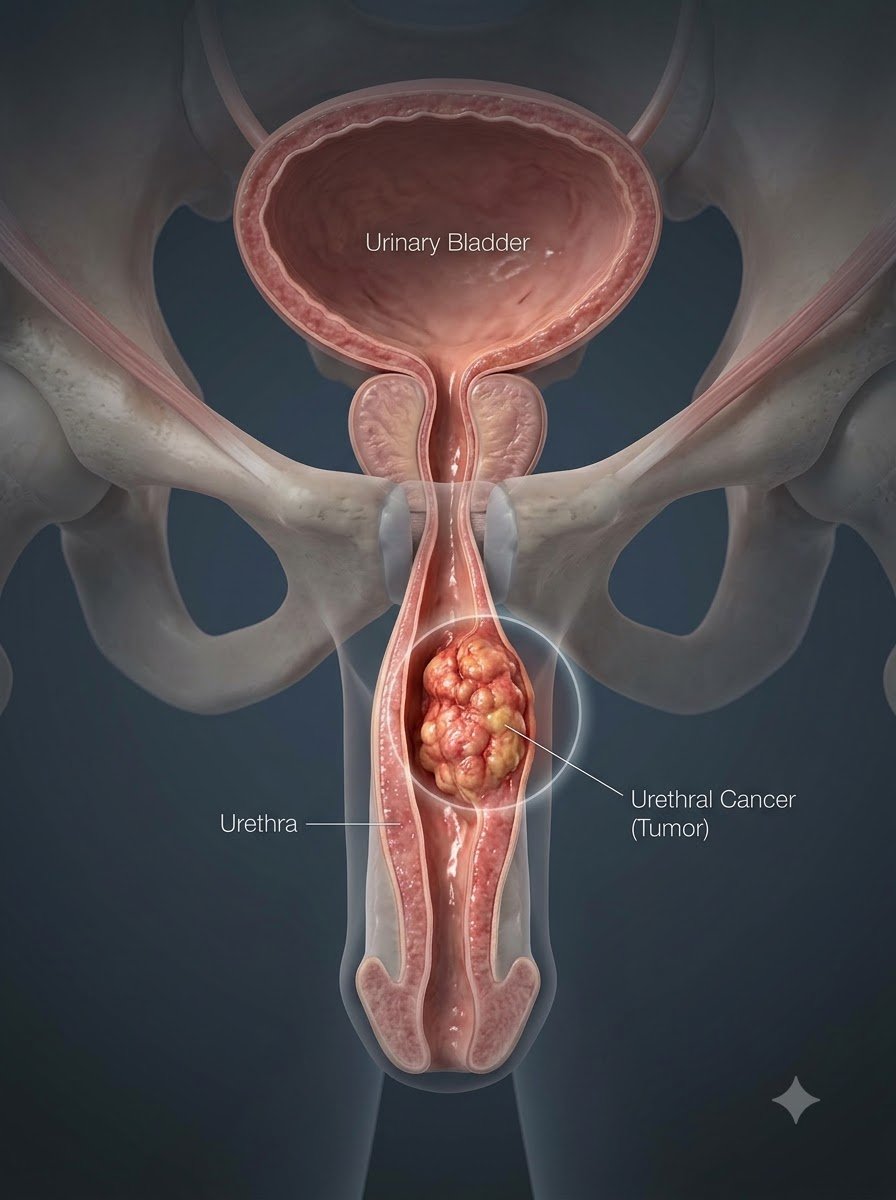
Urethral cancer is a rare cancer that develops in the urethra, the tube that carries urine from the bladder to outside the body. It can occur in both men and women.
Different types of cancer can develop from cells lining the urethra. Squamous cell carcinoma is the most common type, while urothelial carcinoma and adenocarcinoma are less common.
Because the urethra has different anatomical portions, treatment depends strongly on whether the tumour is located in the distal or proximal urethra and how deeply it has invaded surrounding tissues.
Urethral cancer is uncommon and can involve different portions of the urethra. Accurate diagnosis and staging are important before deciding on treatment.
The location of a urethral tumour is an important part of treatment planning.
The portion of the urethra closer to where urine leaves the body. Tumours in this region may sometimes be approached with local or organ-preserving treatment when appropriate.
The portion closer to the bladder. Tumours in this region can involve deeper surrounding structures and may require more extensive treatment.
In men, the urethra passes through the prostate and penis before opening externally.
In women, the urethra is shorter and opens anterior to the vaginal opening.
Squamous cell carcinoma is the most common type of urethral cancer and develops from squamous cells lining the urethra.
Urothelial carcinoma develops from urothelial cells and can occur in portions of the urethra associated with the urinary tract lining.
Adenocarcinoma develops from glandular tissue around the urethra and is less common than squamous cell carcinoma.
Tumours that extend deeply into tissues around the urethra may require more extensive local treatment and staging.
Urethral cancer may not cause symptoms in its early stages. Possible symptoms can include:
Bleeding from the urethra or blood in the urine can occur.
Trouble starting the urine stream or difficulty passing urine may occur.
A weak or stop-and-start urine stream can be a possible symptom.
Unusual discharge from the urethra may require medical evaluation.
A lump or thickening around the penis or perineum may be present.
A painless lump or swelling in the groin can occur when nearby lymph nodes are involved.
Having a risk factor does not mean that a person will develop urethral cancer, but certain conditions may increase risk.
A history of bladder cancer can be associated with an increased risk of urethral cancer.
Long-standing inflammation of the urethra can be associated with urethral cancer risk.
Certain HPV infections, particularly HPV type 16, have been associated with urethral cancer.
Frequent urinary tract infections and chronic irritation may be associated with increased risk.
Diagnosis begins with evaluation of urinary symptoms and physical examination. Additional tests are used to identify the tumour, determine its extent and establish the appropriate treatment plan.
Endoscopic examination can directly evaluate the urethra and bladder, while imaging helps assess local involvement and possible spread.
A biopsy may be required to establish the histological type and other pathological characteristics of the tumour.
Treatment decisions consider the tumour's anatomical location, size, depth of invasion, stage and lymph node involvement.
Examination can help identify visible abnormalities, masses or enlarged lymph nodes.
Endoscopic examination allows direct assessment of the urethral lining and suspicious lesions.
Tissue examination can determine the type and characteristics of the cancer.
MRI and other imaging studies may help determine local tumour extent and evaluate surrounding structures.
The anatomical location of the tumour is one of the key factors guiding treatment.
Selected superficial distal tumours may be approached with local excision, transurethral treatment or laser-based techniques. Treatment varies between men and women and depends on tumour depth and location.
Proximal tumours may involve deeper tissues and nearby pelvic structures. Treatment can require radiation, chemotherapy, extensive surgery and urinary diversion depending on the extent of disease.
Surgery is a major treatment modality for urethral cancer. The operation depends on tumour location, depth, stage and the structures involved.
Selected localized tumours may be removed while attempting to preserve surrounding structures.
A specialised instrument can be introduced through the urethra to remove selected superficial tumours.
A portion of the urethra may be removed when the tumour location and extent permit a more limited surgical approach.
Deeper or more extensive tumours may require removal of additional involved structures to achieve appropriate cancer treatment.
Some superficial or early urethral tumours may be treated with approaches designed to preserve as much normal anatomy and function as possible.
Depending on tumour characteristics, options can include local excision, transurethral resection, electroresection, fulguration or laser treatment.
Organ preservation is not suitable for every tumour. The risk of recurrence and the ability to achieve appropriate cancer control must be considered.
For carefully selected tumours, less extensive treatment may be considered while maintaining appropriate oncological principles.
In men, treatment depends on whether the tumour involves the distal penile urethra or a more proximal portion.
Selected superficial tumours may be treated with local excision, transurethral treatment or laser techniques.
Tumours involving portions of the penis may require partial penectomy when appropriate.
Deep proximal disease may require more extensive surgery involving the urethra and adjacent structures.
Radiation and chemotherapy may be incorporated into treatment for selected locally advanced tumours.
Treatment depends on tumour size, location, depth and involvement of surrounding pelvic structures.
Selected distal and superficial tumours may be considered for local surgical removal.
Some superficial lesions may be treated using transurethral techniques.
External radiation or brachytherapy may be considered in selected tumours according to location and depth.
Deep or extensive disease may require more extensive surgery and urinary diversion in selected cases.
Urethral cancer can spread to nearby lymph nodes. Whether lymph node surgery is needed depends on the tumour location, clinical findings and stage.
In some distal urethral cancers, the inguinal lymph nodes may need evaluation when clinical involvement is suspected.
More proximal disease may involve pelvic lymph nodes and require appropriate staging.
Lymph node removal may form part of treatment in selected patients with appropriate indications.
When extensive surgery requires removal of the urethra or bladder, the normal pathway for urine may need to be reconstructed.
Depending on the operation and the patient's circumstances, urinary diversion can involve creating a new route for urine using a segment of the intestine.
The appropriate reconstruction is determined as part of the surgical treatment plan and depends on the structures removed and the patient's overall health.
When normal urinary passage is no longer possible, reconstructive techniques can create an alternative route for urine to leave or be stored by the body.
Depending on tumour stage and location, urethral cancer treatment may involve surgery, radiation, chemotherapy or a combination of approaches.
External-beam radiation or brachytherapy may be considered for selected urethral cancers, depending on location and extent.
Chemotherapy may be used with radiation or surgery in selected locally advanced cancers and may have a role in metastatic disease.
In carefully selected circumstances, active surveillance may be considered with regular examinations and testing.
Locally advanced or metastatic disease may require a combination of systemic therapy, radiation and surgery according to the individual treatment plan.
Treatment is reassessed according to where the disease has returned, whether it can be removed, previous treatment and overall health.
Selected local recurrences may be treated with surgery, radiation or a combination of approaches.
Regional lymph node involvement may require additional staging and treatment planning.
When cancer has spread to distant sites, systemic treatment generally becomes an important part of care.
Clinical trials may be considered for selected patients depending on disease characteristics and available studies.
Because urethral cancer is rare, treatment planning requires careful assessment of the individual tumour and the surrounding anatomy.
Establish the tumour type through appropriate examination and pathology.
Determine its location, size and depth of involvement.
Assess surrounding structures and regional or distant spread.
Consider surgery, radiation, chemotherapy or combined treatment according to the individual case.

Dr. Nitin Singhal is a surgical oncologist in Ahmedabad with experience in complex cancer surgery and multidisciplinary cancer care.
Urethral cancer treatment requires careful assessment of tumour location, depth and stage. Surgical planning is tailored to the individual patient's disease and overall condition.
Urethral cancer is a rare cancer affecting the urethra, the tube through which urine leaves the body. It can occur in both men and women and may arise in different portions of the urethra.
The most common type is squamous cell carcinoma, although urothelial carcinoma and adenocarcinoma can also occur. Diagnosis usually involves clinical assessment, endoscopic examination, imaging and tissue evaluation when appropriate.
Treatment depends on the location and extent of the cancer. Selected superficial tumours may be treated with local excision, transurethral resection or laser-based techniques. More extensive disease may require urethral resection, partial or radical penectomy, pelvic surgery, lymph node surgery or urinary diversion, depending on the individual case.
Radiation therapy and chemotherapy may also form part of treatment for selected patients, particularly when disease is locally advanced or when combined treatment is being considered.
If you have been diagnosed with urethral cancer or have symptoms requiring evaluation, a specialist consultation can help clarify the diagnosis, stage and available treatment options.
Common questions about urethral cancer symptoms, diagnosis and treatment.
Get a personalised evaluation to understand your diagnosis, tumour location, stage and available surgical and multidisciplinary treatment options.

Dr. Nitin Singhal has been recognised for his contribution to cancer care and surgical oncology, reflecting his commitment to advanced surgical techniques, clinical excellence and patient-centred care.
Surgical oncology training from Tata Memorial Hospital, Mumbai.
Expertise across complex and multidisciplinary cancer surgery.
Honoured for excellence in healthcare and surgical oncology.
Focus on evidence-based and personalised cancer treatment.
Recognition that reflects a continued commitment to excellence in cancer care.

