Comprehensive evaluation and treatment planning for bone tumours, including primary bone cancers, with management tailored according to tumour type, location, size, grade and stage.
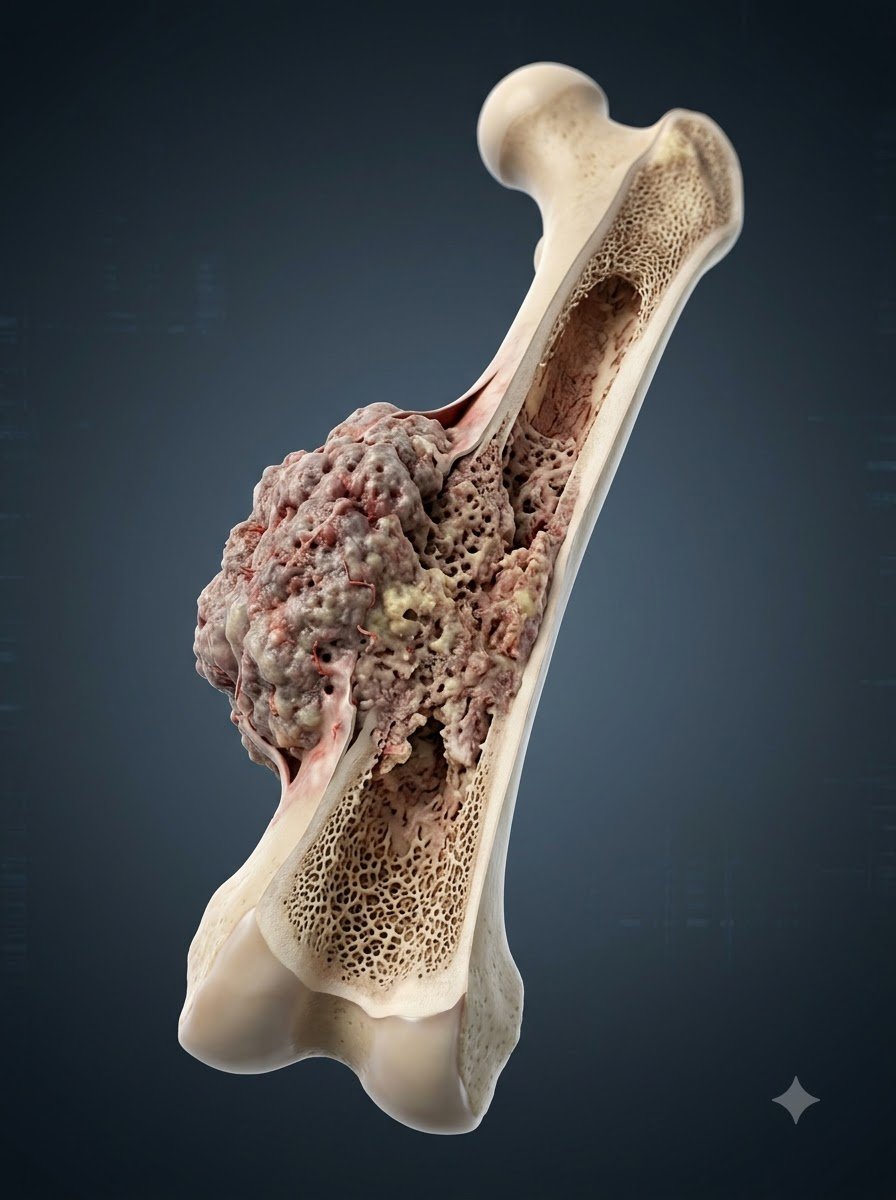
Bone tumours are abnormal growths that develop within or on bones. They may be benign, meaning they are not cancerous, or malignant, meaning they are cancerous.
Primary bone cancers begin in cells or tissues associated with the bone itself. Other cancers can also spread to bones from organs elsewhere in the body; these are called metastatic or secondary bone tumours.
Because different bone tumours behave differently, diagnosis, biopsy planning and treatment need to be tailored to the specific tumour.
Bone tumours can be benign or malignant. Imaging and, when appropriate, carefully planned biopsy help establish the diagnosis.
Understanding whether a tumour started in the bone or spread there from another cancer is an important part of treatment planning.
Cancer that begins in the cells or tissues associated with the bone. Important malignant types include osteosarcoma, chondrosarcoma and Ewing sarcoma.
Cancer that begins elsewhere in the body and subsequently spreads to the bone. Treatment is generally based on the original cancer and the extent of metastatic disease.
Bone tumours can occur in almost any bone, with certain tumour types showing characteristic anatomical patterns.
The thighbone and bones around the knee are important sites for some primary bone cancers, particularly osteosarcoma.
Bone tumours can develop in the pelvis and may require complex surgical planning because of nearby organs, nerves and blood vessels.
Tumours around the shoulder or upper arm may require specialised limb-sparing and reconstructive procedures.
Bone tumours can also occur in the spine, ribs, skull and other skeletal structures.
A malignant tumour arising from bone-forming cells. It commonly affects the long bones, particularly around the knee and shoulder, although it can develop in other bones.
A cancer arising from cartilage-forming tissue. It commonly develops in the pelvis, upper leg and shoulder and is more common in adults.
A malignant tumour that commonly affects bone or, less commonly, soft tissue. It is more frequently diagnosed in children, adolescents and young adults.
A rare malignant bone tumour that is generally treated using approaches similar to those used for osteosarcoma.
A rare malignant tumour that develops from remnants of embryonic structures and most often occurs along the spine or at the base of the skull.
Other uncommon malignant and intermediate bone tumours require individual pathological assessment and specialised treatment planning.
Benign bone tumours are different from primary bone cancers and may be managed with observation, medication or surgery depending on their behaviour and symptoms.
A common benign bone growth that can occur near the growth plates of long bones.
A benign cartilage tumour that develops inside the bone and is often discovered incidentally.
Usually a locally aggressive bone tumour that commonly develops near the ends of long bones in adults.
A blood-filled bone lesion that can expand the bone and sometimes requires surgical treatment.
Symptoms vary according to the location and type of bone tumour.
Persistent or progressively worsening pain in a bone can be a symptom of a bone tumour and should be appropriately evaluated.
A swelling or palpable mass over a bone may occur as a tumour enlarges.
Tumours near a joint can interfere with movement and cause stiffness or discomfort.
Some tumours can weaken the affected bone and increase the risk of a pathological fracture.
A weakened bone can sometimes fracture with relatively little trauma.
Tumours near nerves or the spine may cause numbness, weakness, tingling or other neurological symptoms.
Evaluation usually begins with clinical examination and appropriate imaging. X-rays can provide an initial view of the bone, while MRI is particularly useful for defining local tumour extent.
CT can provide additional information about bone structure and is commonly used to assess the chest for possible lung metastases in malignant bone tumours.
A biopsy may be required to determine the exact tumour type. Importantly, the biopsy should be planned together with the team that will perform definitive surgery.
An improperly placed biopsy can complicate subsequent limb-sparing surgery. Biopsy planning is therefore an important part of bone tumour management.
X-rays can show changes in bone structure and may provide important initial clues about a bone tumour.
MRI helps determine the size and local extent of the tumour and its relationship with nearby muscles, nerves and blood vessels.
CT provides detailed information about bone anatomy and can also help assess the chest for possible metastatic disease.
Tissue examination can establish the tumour type, grade and other pathological features important for treatment.
Different bone tumours respond differently to surgery, chemotherapy and radiation.
Newly diagnosed osteosarcoma is commonly managed with chemotherapy together with definitive surgery.
Surgery is an important treatment for chondrosarcoma, while the exact approach depends on subtype, grade and location.
Ewing sarcoma generally requires systemic chemotherapy combined with local control using surgery and/or radiation.
Rare bone tumours require treatment based on their specific pathology, anatomical location and stage.
Surgery aims to remove the tumour completely while preserving as much useful function as safely possible.
The tumour and a margin of surrounding normal tissue are removed to achieve complete tumour resection.
For selected tumours of the arms and legs, the tumour can be removed while preserving the limb.
The removed section of bone may be reconstructed using a bone graft, prosthesis or another reconstructive technique.
Amputation may be considered when complete tumour removal cannot be safely achieved while preserving a functional limb.
Modern surgical techniques allow many selected tumours of the arms and legs to be treated without removing the entire limb.
Limb-sparing surgery removes the bone tumour and surrounding involved tissue while preserving the remaining limb.
The feasibility of limb salvage depends on the tumour's size, location and involvement of important nerves, blood vessels, muscles and other structures.
Reconstruction may involve an internal prosthesis, bone graft or another specialised reconstructive technique.
The surgical goal is not simply to remove the tumour, but to do so while preserving as much useful limb function as oncologically safe.
Removing part of a bone can create a structural gap that may require reconstruction.
A metal or other internal prosthesis can replace a section of removed bone and, in some cases, an adjacent joint.
Bone graft material can be used to reconstruct selected bone defects after tumour removal.
Selected patients may undergo reconstruction using biological bone techniques depending on the tumour and anatomical site.
When a tumour involves a joint region, reconstruction may be needed to restore stability and useful movement.
Amputation is considered only when it provides the safest way to achieve complete tumour removal or when limb salvage would not provide a useful functional result.
A tumour that extensively involves major nerves or blood vessels, or one that cannot be completely removed while preserving a functional limb, may require amputation.
The decision is based on detailed imaging, tumour extent, pathology and the expected function of the preserved limb.
Rehabilitation and prosthetic planning are important components of care when amputation is required.
Limb-sparing surgery is evaluated whenever it can provide complete tumour removal with an acceptable functional result.
Chemotherapy plays an important role in selected primary bone cancers, particularly osteosarcoma and Ewing sarcoma.
Newly diagnosed osteosarcoma is commonly treated with chemotherapy before and after definitive surgery.
Ewing sarcoma generally requires systemic chemotherapy together with local control using surgery and/or radiation.
Conventional chemotherapy is not typically used for most chondrosarcomas, although treatment depends on the specific subtype.
The need for chemotherapy depends on the exact bone tumour type, stage, grade and treatment strategy.
Radiation has an important role in selected bone cancers and situations where complete surgery is not possible or disease remains.
Radiation can be used as part of local tumour control for selected Ewing sarcoma cases.
Radiation may be considered when a tumour cannot be completely removed surgically.
Selected patients may receive radiation when a small amount of tumour remains after surgery.
Radiation can also be used to relieve pain and other symptoms from selected bone tumours or metastatic disease.
Giant cell tumour is usually benign but can behave aggressively and may damage surrounding bone.
Giant cell tumours commonly develop near the ends of long bones, often close to a joint.
Treatment depends on the tumour's size, location, structural damage and whether it can be completely removed while preserving useful joint function.
Surgical options can include curettage, reconstruction or more extensive resection in selected cases.
Although giant cell tumour is generally not classified as a typical bone cancer, it can cause substantial local bone destruction.
Bone metastases are different from primary bone cancer and are treated according to the original cancer and the extent of spread.
Cancers from organs such as the breast, prostate, lung or kidney can spread to the bones.
Surgery may be considered when metastatic disease has weakened a bone and creates a significant risk of fracture or loss of function.
Radiation can be used to relieve pain and provide local control for selected bone metastases.
Systemic treatment is generally selected according to the primary cancer and its molecular characteristics.
Some primary bone cancers can spread to the lungs, other bones or other parts of the body.
The lungs are an important site of distant spread for osteosarcoma and Ewing sarcoma.
Selected patients with limited metastatic disease may be evaluated for surgical removal of metastases.
Chemotherapy or other systemic treatments may be used according to tumour type and stage.
Radiation may be used for selected metastatic sites or for symptom relief.
Recurrent disease requires reassessment of its location, previous treatment and whether the recurrence can be treated locally.
Repeat surgery may be considered for selected tumours that return at or near the original site.
Selected patients with isolated or limited lung recurrence may be considered for surgical treatment.
Additional chemotherapy or other systemic approaches may be considered depending on tumour type and previous treatment.
Recurrent bone cancer often requires coordinated review by surgical, medical and radiation oncology specialists.
Rehabilitation is an important part of recovery after limb-sparing surgery, reconstruction or amputation.
Physical therapy helps restore strength, mobility and functional movement after surgery.
The timing and degree of weight bearing depend on the operation, reconstruction and bone healing.
Patients undergoing amputation may require prosthetic assessment and structured rehabilitation.
Regular follow-up is important to monitor healing, function and possible recurrence.
Bone tumour treatment can require coordination between several specialists before definitive treatment begins.
Evaluates tumour resectability, surgical margins and limb-sparing possibilities.
Confirms the tumour type, grade and other important pathological characteristics.
Determines the role of chemotherapy and other systemic treatments where appropriate.
Evaluates whether radiation can contribute to local tumour control or symptom management.
Treatment depends on the exact tumour diagnosis rather than simply the presence of a mass in the bone.
Define the tumour's location, size and relationship with nearby structures.
Obtain tissue in a manner that does not unnecessarily compromise subsequent surgery.
Establish whether the lesion is benign, malignant or metastatic and determine the specific pathology.
Plan surgery, chemotherapy, radiation or combined treatment according to the tumour and stage.

Dr. Nitin Singhal is a surgical oncologist in Ahmedabad with experience in complex cancer surgery and multidisciplinary cancer care.
Bone tumour treatment requires careful assessment of the tumour's pathology, location, stage and relationship with surrounding structures. Surgical planning focuses on complete tumour removal while considering reconstruction and preservation of function when appropriate.
Bone tumours are abnormal growths that develop in the skeleton and may be benign or malignant. Primary bone cancers include osteosarcoma, chondrosarcoma and Ewing sarcoma, while cancers that spread to the bone from another organ are considered metastatic bone tumours.
Symptoms can include persistent bone pain, swelling, a lump, restricted movement or a pathological fracture. Evaluation may include X-rays, MRI, CT and other appropriate imaging. When a biopsy is required, it should be carefully planned with the team performing definitive treatment.
Surgery is an important treatment for many primary bone cancers. Depending on the tumour and its location, treatment can include wide excision, limb-sparing surgery and reconstruction. Amputation may be considered when complete tumour removal cannot be safely achieved while preserving a functional limb.
Chemotherapy has an important role in selected primary bone cancers, particularly osteosarcoma and Ewing sarcoma. Radiation therapy can also be used in selected situations, including Ewing sarcoma, unresectable disease and certain cases where residual disease or symptoms require local treatment.
Advanced or recurrent bone cancer may require a combination of surgery, systemic treatment and radiation. Treatment depends on the specific tumour type, location, stage, previous treatment and overall health.
If you have been diagnosed with a bone tumour or have persistent bone pain, swelling or an unexplained mass, specialist evaluation can help establish the diagnosis and determine the appropriate treatment plan.
Common questions about bone tumours, diagnosis, surgery and treatment.
Get a personalised evaluation to understand your bone tumour diagnosis, stage, surgical options and available multidisciplinary treatment approaches.

Dr. Nitin Singhal has been recognised for his contribution to cancer care and surgical oncology, reflecting his commitment to advanced surgical techniques, clinical excellence and patient-centred care.
Surgical oncology training from Tata Memorial Hospital, Mumbai.
Expertise across complex and multidisciplinary cancer surgery.
Honoured for excellence in healthcare and surgical oncology.
Focus on evidence-based and personalised cancer treatment.
Recognition that reflects a continued commitment to excellence in cancer care.

