Penile cancer is a rare cancer that most often develops in the skin or tissues of the penis. Treatment depends on the tumour's location, depth, stage and whether nearby lymph nodes are involved. Whenever appropriate, treatment may aim to remove the cancer while preserving as much normal tissue and function as possible.
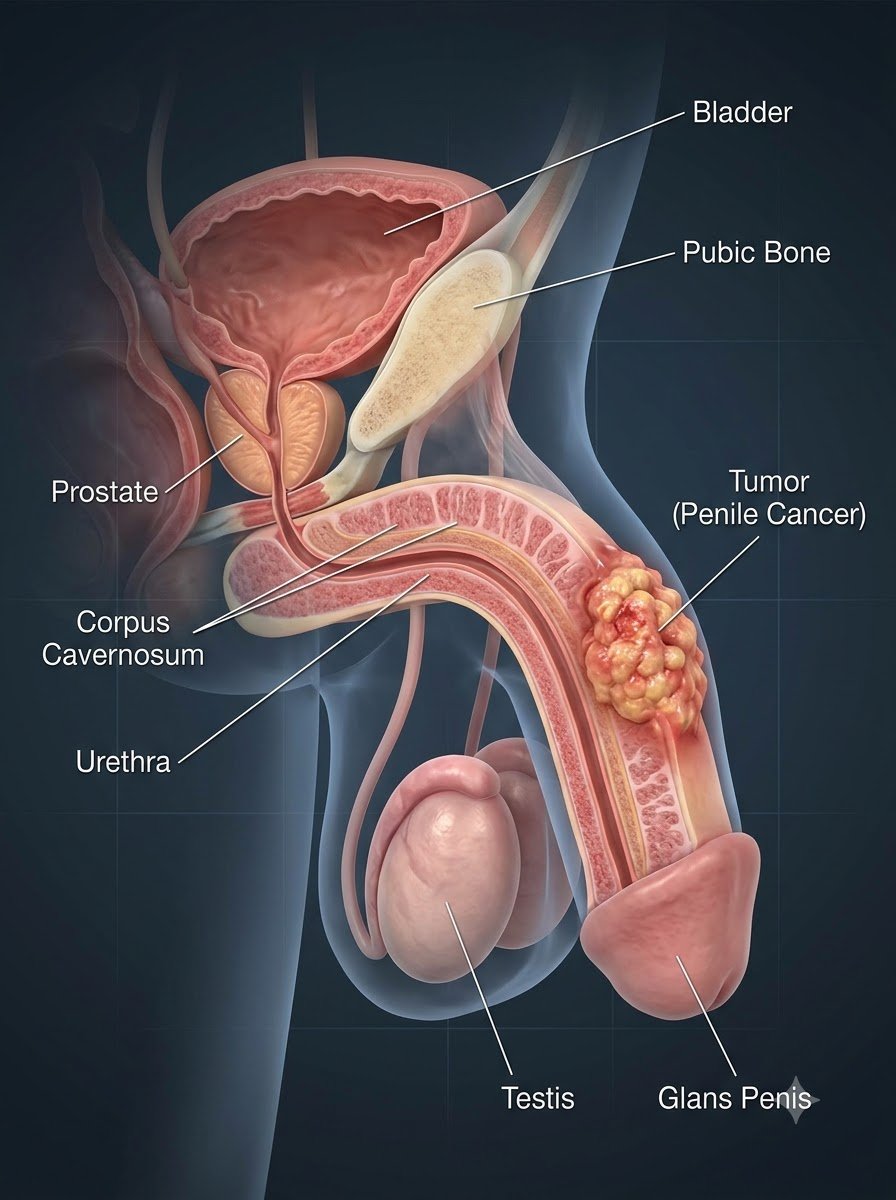
Penile cancer develops when abnormal cells in the tissues of the penis begin to grow uncontrollably. Most penile cancers are squamous cell carcinomas, which develop from the skin cells of the penis.
Penile cancer can develop on the foreskin, glans or other parts of the penis. The depth and location of the tumour are important when deciding which treatment may be appropriate.
When diagnosed early, selected tumours can sometimes be treated with less extensive or penile-sparing procedures.
A persistent lesion, ulcer, lump, change in skin appearance or other unexplained abnormality should be evaluated rather than assumed to be an infection or minor skin condition.
The location of the tumour is one of the factors that influences treatment planning.
Cancer can develop on or beneath the foreskin. Selected cancers limited to the foreskin may be treated with circumcision.
The glans, or head of the penis, is a common location for penile cancer and may be treated with selected local or surgical approaches depending on tumour depth.
Tumours involving deeper tissues of the shaft may require more extensive surgery depending on their size and depth.
Penile cancer can spread to lymph nodes in the groin, making lymph-node assessment an important part of staging for selected patients.
The most common type of penile cancer, arising from the squamous cells of the penile skin and mucosal surfaces.
Abnormal cancer-like cells are confined to the surface layer and have not invaded deeper tissues.
Cancer that has grown beyond the surface layer and into deeper tissues of the penis.
Less common tumours can occur in the penis and may require specialised pathological evaluation and treatment planning.
Penile abnormalities can have many causes, but persistent or unexplained changes should be evaluated by a doctor.
A persistent change in the colour, thickness or appearance of penile skin may require assessment.
An unexplained lump, growth or thickened area on the penis should be evaluated.
A sore or ulcer that does not heal normally may need further investigation.
Unexplained bleeding or discharge from beneath the foreskin can require medical evaluation.
Persistent swelling of the penis or foreskin may occur with several conditions and should be assessed when unexplained.
Enlarged lymph nodes in the groin may require evaluation, particularly when associated with a penile lesion.
Certain types of human papillomavirus, or HPV, are associated with penile cancer.
Difficulty retracting the foreskin can be associated with an increased risk of penile cancer.
Long-standing inflammatory conditions affecting the penis can be associated with increased risk.
Tobacco use is associated with an increased risk of penile cancer.
Diagnosis determines the type of tumour, how deeply it has grown and whether nearby lymph nodes may be involved.
Examination helps assess the location, size and appearance of the penile lesion and any enlarged groin lymph nodes.
A tissue sample is examined under a microscope to confirm whether cancer is present and identify its type.
Imaging may be used in selected patients to assess the primary tumour, lymph nodes or possible spread.
Depending on tumour characteristics, the groin lymph nodes may require additional assessment to determine whether cancer has spread.
When penile cancer is detected at an early stage and has not deeply invaded the penis, less extensive treatments may be possible.
Depending on the tumour location and characteristics, options can include local excision, laser treatment, topical therapy, circumcision, glans resurfacing or other penile-sparing approaches.
The goal in selected cases is to remove or destroy the cancer while preserving as much normal penile tissue as safely possible.
Penile-sparing treatment is considered only when it provides appropriate cancer control. The depth, location and pathology of the tumour are important when choosing the treatment.
The extent of surgery depends primarily on where the tumour is located and how deeply it has invaded the penis.
When cancer is limited to the foreskin, circumcision may be an appropriate treatment in selected cases.
The tumour and a surrounding margin of normal tissue may be removed while preserving the remaining penis.
Selected tumours involving the glans may require removal of the glans while preserving the remaining penile shaft when appropriate.
For deeper tumours, part of the penis may need to be removed to achieve appropriate cancer clearance.
When penile cancer has grown deeply into the penis, more extensive surgery may be required to remove the tumour with appropriate margins.
A partial penectomy removes part of the penis when adequate tissue can remain. A total penectomy removes the entire penis and may require creation of a new opening for urine to pass through the perineum.
The exact operation depends on the tumour's location, depth and extent.
The aim is appropriate cancer removal while preserving as much normal tissue and function as safely possible whenever the tumour allows it.
Penile cancer can spread to lymph nodes in the groin. The need for lymph node assessment depends on tumour characteristics and the likelihood of regional spread.
In selected clinically node-negative patients, sentinel lymph node biopsy can help determine whether cancer has reached the first draining groin lymph nodes.
When cancer is confirmed in the groin lymph nodes or the risk of nodal spread is sufficiently high, more extensive lymph node surgery may be considered.
When penile cancer has spread to the inguinal lymph nodes, lymph node surgery may become an important part of treatment.
In selected patients, pelvic lymph nodes may also need to be assessed or removed depending on the number and characteristics of involved groin lymph nodes.
Lymph node treatment helps determine the extent of regional disease and may be an important component of treatment when penile cancer has spread beyond the primary tumour.
In selected patients and specialised centres, minimally invasive or robotic approaches may be considered for inguinal or pelvic lymph node surgery.
Robotic-assisted lymph node surgery may be considered for selected patients when appropriate expertise and patient selection are available.
The procedure is designed to remove and examine the lymph nodes responsible for draining the penile region.
Pelvic lymph node surgery may be considered in selected patients with more extensive regional nodal disease.
Lymph node surgery is complex and the appropriate approach depends on tumour stage, nodal involvement and overall health.
More advanced penile cancer may require a combination of surgery, chemotherapy, radiation therapy or systemic treatment depending on where the disease has spread.
When the tumour extends into nearby structures, more extensive surgery may be considered when complete removal is feasible.
When cancer has spread extensively or to distant parts of the body, systemic treatment may become an important part of care.
Surgery is the most common treatment for penile cancer, but radiation and other treatments may be appropriate depending on the tumour and stage.
Radiation may be considered for selected penile cancers and may also be used in specific situations involving regional disease.
Chemotherapy may be used for selected advanced cancers or around surgery depending on the stage and treatment plan.
Laser treatment may be considered for selected superficial or early penile tumours.
Certain very early surface cancers or precancerous lesions may be treated with topical medicines in selected cases.
Penile cancer treatment is individualised. The location and size of the primary tumour, depth of invasion, tumour grade, lymph node involvement and presence of distant disease all influence treatment planning.
When possible, treatment may aim to preserve the penis while maintaining appropriate cancer control. More extensive surgery may be necessary when the tumour has invaded deeper tissues.
Penile-sparing treatment is considered only when it provides appropriate oncological treatment. The safest approach depends on the individual tumour.
Penile cancer treatment can affect physical function and emotional wellbeing. Recovery depends on the type and extent of treatment.
The way a person urinates can change after more extensive penile surgery. The surgical approach is planned with these functional considerations in mind.
The effect on sexual function depends on the tumour and the type of treatment. Less extensive treatment may preserve more function in selected patients.
Penile cancer treatment can affect body image and emotional wellbeing, making supportive care an important part of recovery.
Groin lymph node surgery can affect lymphatic drainage and may cause swelling of the legs or genital area in some patients.

Dr. Nitin Singhal is a surgical oncologist in Ahmedabad with experience in the surgical management of gastrointestinal, urological and other cancers.
His areas of surgical oncology include urological cancer surgery, robotic cancer surgery, gastrointestinal cancer surgery, HIPEC and other complex cancer procedures.
Penile cancer is a rare cancer that can develop on the foreskin, glans or other parts of the penis. Treatment depends on the tumour's location, depth, grade and stage.
When penile cancer is diagnosed early, selected patients may be candidates for penile-sparing treatments such as local excision, circumcision, laser treatment or other limited procedures.
Deeper tumours may require glansectomy, partial penectomy or, when necessary, total penectomy. The goal is to remove the cancer adequately while preserving as much normal tissue and function as the tumour safely allows.
Penile cancer can spread to the lymph nodes in the groin. Depending on the tumour characteristics and stage, sentinel lymph node assessment or inguinal lymph node dissection may be required.
Advanced disease may require a combination of surgery, chemotherapy, radiation therapy or other systemic treatments. The appropriate treatment depends on the individual diagnosis and extent of disease.
If you have noticed a persistent penile lesion, lump, ulcer or other unexplained change, or have already been diagnosed with penile cancer, a specialist evaluation can help clarify the diagnosis and available treatment options.
Selected early penile cancers can sometimes be treated with penile-sparing approaches such as local excision, circumcision, laser treatment, glans resurfacing or other limited procedures. Suitability depends on the tumour's location and depth.
A partial penectomy removes part of the penis containing the cancer while preserving the remaining shaft when adequate cancer clearance is possible.
Total penectomy may be required when the tumour is too extensive or deeply invasive to be adequately removed while preserving enough of the penis. The exact surgical decision depends on tumour location and extent.
Yes. Penile cancer can spread to lymph nodes in the groin. Depending on the tumour's depth, grade and other risk factors, lymph node assessment may be recommended.
A sentinel lymph node biopsy identifies and removes the first lymph node or nodes most likely to receive drainage from the primary tumour. Pathological examination can help determine whether cancer has spread.
An inguinal lymph node dissection removes lymph nodes from the groin for treatment and pathological assessment when penile cancer has spread to, or has a significant risk of spreading to, these nodes.
Radiation therapy can be used for selected penile cancers. Whether it is appropriate depends on the tumour's size, location, depth, stage and the patient's overall situation.
Possible signs include a persistent lump, growth, ulcer, skin change, bleeding, discharge or swelling. These findings can also have non-cancerous causes, but persistent unexplained changes should be evaluated.
It can. The effect depends on the location and extent of the cancer and the treatment used. When appropriate, less extensive treatment may preserve more normal tissue and function.
Advanced penile cancer may require a combination of surgery, lymph node treatment, chemotherapy, radiation therapy or other systemic treatments. The treatment plan depends on where the cancer has spread and previous treatment.
Get a personalised evaluation to understand your diagnosis, tumour stage, surgical options and whether penile-sparing or other cancer treatment may be appropriate for your condition.

Dr. Nitin Singhal has been recognised for his contribution to cancer care and surgical oncology, reflecting his commitment to advanced surgical techniques, clinical excellence and patient-centred care.
Surgical oncology training from Tata Memorial Hospital, Mumbai.
Expertise across complex and multidisciplinary cancer surgery.
Honoured for excellence in healthcare and surgical oncology.
Focus on evidence-based and personalised cancer treatment.
Recognition that reflects a continued commitment to excellence in cancer care.

