Comprehensive evaluation and treatment planning for uterine cancer, including endometrial cancer and selected uterine sarcomas, with the approach tailored according to tumour type, stage, grade and overall health.
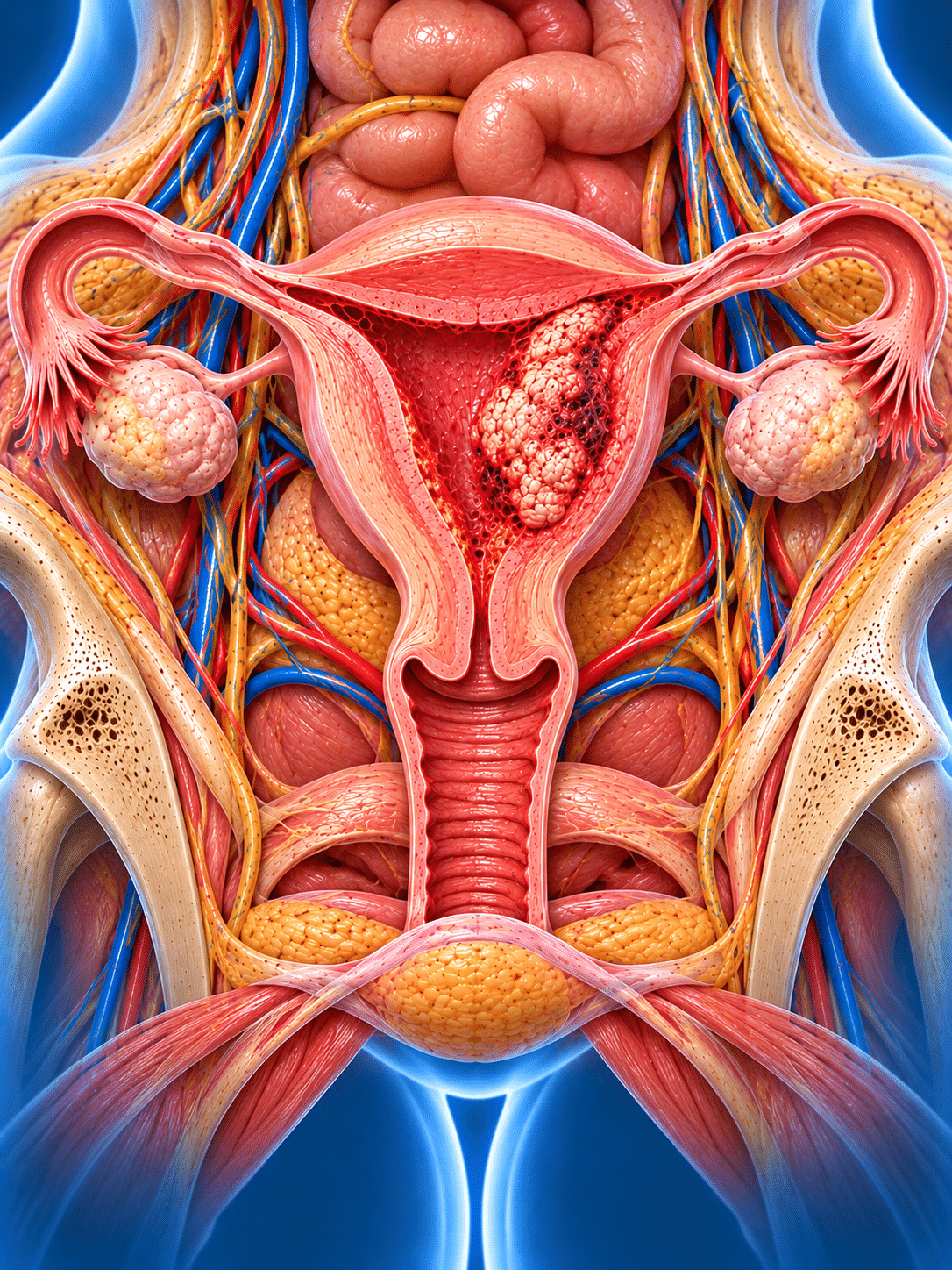
Uterine cancer develops in tissues of the uterus. The two broad categories are endometrial cancer, which begins in the lining of the uterus, and uterine sarcoma, which develops in the uterine muscle or supporting tissues.
Endometrial cancer is the more common type of uterine cancer. Uterine sarcomas are uncommon and include several distinct tumour types with different biological behaviour and treatment approaches.
Treatment depends on the tumour type, grade, stage, depth of invasion, lymph node involvement and the patient's overall health.
Endometrial cancer begins in the uterine lining, while uterine sarcomas arise from the muscle or supporting tissues of the uterus.
Different tissues of the uterus can give rise to different types of cancer.
The inner lining of the uterus. Most uterine cancers develop from this tissue and are classified as endometrial cancers.
The muscular wall of the uterus. Rare uterine sarcomas such as leiomyosarcoma can develop from this tissue.
The outer covering of the uterus that forms part of the surface of the uterine body.
The lower part of the uterus that connects to the vagina and is anatomically distinct from the uterine body.
Cancer that begins in the endometrium, the inner lining of the uterus. It is the most common type of uterine cancer.
A rare uterine sarcoma arising from smooth muscle cells of the myometrium.
A rare sarcoma arising from connective tissue within the endometrium and uterine wall.
A rare uterine tumour containing both benign glandular and malignant stromal components.
A high-grade uterine malignancy containing both carcinomatous and sarcomatous components and generally staged with endometrial carcinoma.
Endometrial cancer begins in the lining of the uterus and is often diagnosed because of abnormal uterine bleeding.
The most common histological type of endometrial cancer, often associated with endometrial glandular cells.
A less common but higher-risk type that may require more extensive staging and additional treatment.
A less common high-risk histological type requiring careful staging and treatment planning.
A high-grade tumour with both epithelial and sarcomatous components, managed according to its specific pathology and stage.
Abnormal uterine bleeding is an important symptom that should be medically evaluated.
Any vaginal bleeding after menopause should be evaluated.
Menstrual bleeding that becomes unusually heavy or prolonged can require investigation.
Unexpected bleeding between menstrual cycles can have many causes, including uterine abnormalities.
Persistent pelvic discomfort or pain can occur, particularly with more advanced disease.
A feeling of pelvic pressure or fullness can occur with uterine masses.
Abnormal vaginal discharge can occasionally accompany uterine malignancy.
Risk factors differ between endometrial cancer and uterine sarcoma.
Obesity, prolonged estrogen exposure, diabetes and certain hereditary conditions can increase the risk of endometrial cancer.
Endometrial cancer is more common after menopause, although it can occur before menopause as well.
Previous treatment with tamoxifen has been associated with an increased risk of certain uterine cancers.
Previous radiation treatment to the pelvis is a recognised risk factor for uterine sarcoma.
Certain inherited cancer syndromes, including Lynch syndrome, can increase the risk of endometrial cancer.
Evaluation commonly begins with a history and pelvic examination, followed by imaging and tissue sampling when indicated.
Endometrial biopsy is commonly used to investigate suspected endometrial cancer. Hysteroscopy and dilation and curettage may be considered in selected situations.
Imaging such as ultrasound, MRI, CT or PET-CT may be used depending on the suspected tumour type and stage.
Tumour histology, grade, molecular characteristics and stage can influence the treatment strategy.
A clinical examination evaluates the uterus, cervix, vagina and surrounding pelvic structures.
A tissue sample from the uterine lining can help diagnose endometrial cancer.
A camera may be used to examine the inside of the uterus and obtain targeted tissue samples.
Imaging helps assess the depth of invasion, local extension, lymph nodes and possible distant disease.
Surgery is the main treatment for many localized endometrial cancers. The extent of staging depends on tumour risk and pathology.
Removal of the uterus and cervix is the standard surgical foundation for many endometrial cancers.
Bilateral salpingo-oophorectomy may be performed with hysterectomy depending on the patient's age, tumour characteristics and treatment plan.
Sentinel lymph node assessment may be used for staging in selected patients.
Pelvic and para-aortic lymph node assessment may be considered in higher-risk disease.
Minimally invasive surgery may be considered for selected patients undergoing treatment for uterine cancer.
Laparoscopic and robotic approaches can allow hysterectomy and appropriate staging procedures through smaller surgical incisions in suitable patients.
The choice of surgical approach depends on tumour characteristics, previous operations, overall health and the complexity of the required procedure.
Selected patients may be candidates for laparoscopic or robotic surgery after appropriate clinical assessment.
Lymph node assessment helps determine whether cancer has spread beyond the uterus and can influence additional treatment.
Sentinel lymph node mapping can identify the first lymph nodes most likely to contain cancer cells.
More extensive lymph node assessment may be considered in selected high-risk tumours according to pathology and stage.
Some endometrial cancers have a higher risk of recurrence based on histology, grade, depth of invasion or spread outside the uterus.
Grade 3 and certain high-risk histological types may require additional treatment after surgery.
Deeper invasion into the uterine muscle can increase the risk of recurrence and influence adjuvant treatment planning.
Cancer found in lymph nodes may lead to recommendations for chemotherapy, radiation or both.
Serous, clear cell and carcinosarcoma subtypes may require more extensive staging and additional therapy.
Uterine sarcomas are rare tumours with different biological characteristics from most endometrial cancers.
This sarcoma arises from smooth muscle of the uterus. Surgery is commonly the main treatment when the disease can be completely removed.
These tumours arise from stromal tissue and can have different behaviours depending on grade and hormone receptor status.
A rare tumour containing benign glandular and malignant stromal components that requires individualised surgical planning.
Carcinosarcoma contains both carcinomatous and sarcomatous components and is staged according to endometrial cancer definitions.
Surgery is the most common treatment for uterine sarcoma when the tumour can be removed safely.
Depending on the type and stage, surgery may involve total hysterectomy with removal of both fallopian tubes and ovaries, with lymph node assessment or removal of additional visible tumour when appropriate.
The exact extent of surgery depends on the histological type, stage and distribution of disease.
When feasible, surgery aims to remove all visible cancer while considering the extent of disease and the patient's overall health.
Additional treatment after surgery or treatment for advanced disease depends on the cancer type, stage and pathological risk.
Pelvic radiation or vaginal brachytherapy may be considered for selected endometrial cancers and uterine sarcomas.
Chemotherapy may be used after surgery in selected high-risk cancers or as systemic treatment for advanced disease.
Hormone therapy can be considered for selected hormone-sensitive endometrial cancers or uterine sarcomas.
Selected advanced or recurrent endometrial cancers may be treated with targeted or immunotherapy approaches based on tumour biology.
Advanced or recurrent uterine cancer requires treatment planning based on the site and extent of disease and previous treatment.
Chemotherapy, hormone therapy, targeted therapy or immunotherapy may be considered depending on tumour type and biology.
Radiation may be used to treat selected local or regional disease and to relieve symptoms.
Surgery may be considered for selected patients with resectable recurrent or metastatic disease.
Clinical trials can be considered when available, particularly for advanced or recurrent disease.
Fertility-preserving treatment is possible only in carefully selected patients with specific low-risk endometrial cancers.
Standard surgical treatment for endometrial cancer generally involves hysterectomy. However, selected young patients with carefully assessed low-grade, early-stage endometrial cancer may sometimes be considered for conservative hormone-based treatment.
This approach requires strict patient selection, appropriate pathology review and close follow-up.
Fertility preservation is not appropriate for every uterine cancer, particularly many uterine sarcomas and higher-risk endometrial cancers.
Preserving fertility requires confirmation that the tumour biology and stage make conservative treatment a reasonable option.
The treatment pathway depends on both the type of uterine cancer and its stage.
Establish whether the tumour is endometrial cancer or a uterine sarcoma and determine its specific subtype.
Evaluate tumour grade and relevant pathological or molecular characteristics.
Assess myometrial invasion, cervical involvement, lymph nodes and distant spread when appropriate.
Determine the role of surgery, radiation, chemotherapy, hormone therapy or other systemic treatment.

Dr. Nitin Singhal is a surgical oncologist in Ahmedabad with experience in complex cancer surgery and multidisciplinary cancer care.
Uterine cancer treatment requires careful assessment of tumour histology, grade, stage and spread. Surgical planning is tailored according to the individual disease characteristics and overall treatment strategy.
Uterine cancer refers primarily to cancers arising in the endometrium and the less common uterine sarcomas. Endometrial cancer begins in the lining of the uterus, while uterine sarcomas develop from the muscle or supporting tissues.
Abnormal vaginal bleeding, particularly bleeding after menopause, is an important symptom that requires medical evaluation. Diagnosis may involve pelvic examination, endometrial biopsy, hysteroscopy and imaging.
Surgery is the main treatment for many localized uterine cancers. Endometrial cancer is commonly treated with hysterectomy and appropriate surgical staging. Selected patients may undergo sentinel lymph node mapping or more extensive lymph node assessment.
Uterine sarcomas are uncommon and include leiomyosarcoma, endometrial stromal sarcoma and adenosarcoma. Surgery is commonly the principal treatment when these tumours can be removed, while chemotherapy and radiation may be considered depending on stage and tumour type.
If you have been diagnosed with uterine cancer or have unexplained abnormal uterine bleeding, specialist evaluation can help clarify the diagnosis, stage and available treatment options.
Common questions about uterine cancer diagnosis, surgery and treatment.
Get a personalised evaluation to understand your diagnosis, tumour type, cancer stage and available surgical and multidisciplinary treatment options.

Dr. Nitin Singhal has been recognised for his contribution to cancer care and surgical oncology, reflecting his commitment to advanced surgical techniques, clinical excellence and patient-centred care.
Surgical oncology training from Tata Memorial Hospital, Mumbai.
Expertise across complex and multidisciplinary cancer surgery.
Honoured for excellence in healthcare and surgical oncology.
Focus on evidence-based and personalised cancer treatment.
Recognition that reflects a continued commitment to excellence in cancer care.

