Bile duct cancer, also called cholangiocarcinoma, develops in the network of ducts that carry bile from the liver to the intestine. Treatment depends on the tumour's location, extent, resectability and the patient's overall health.
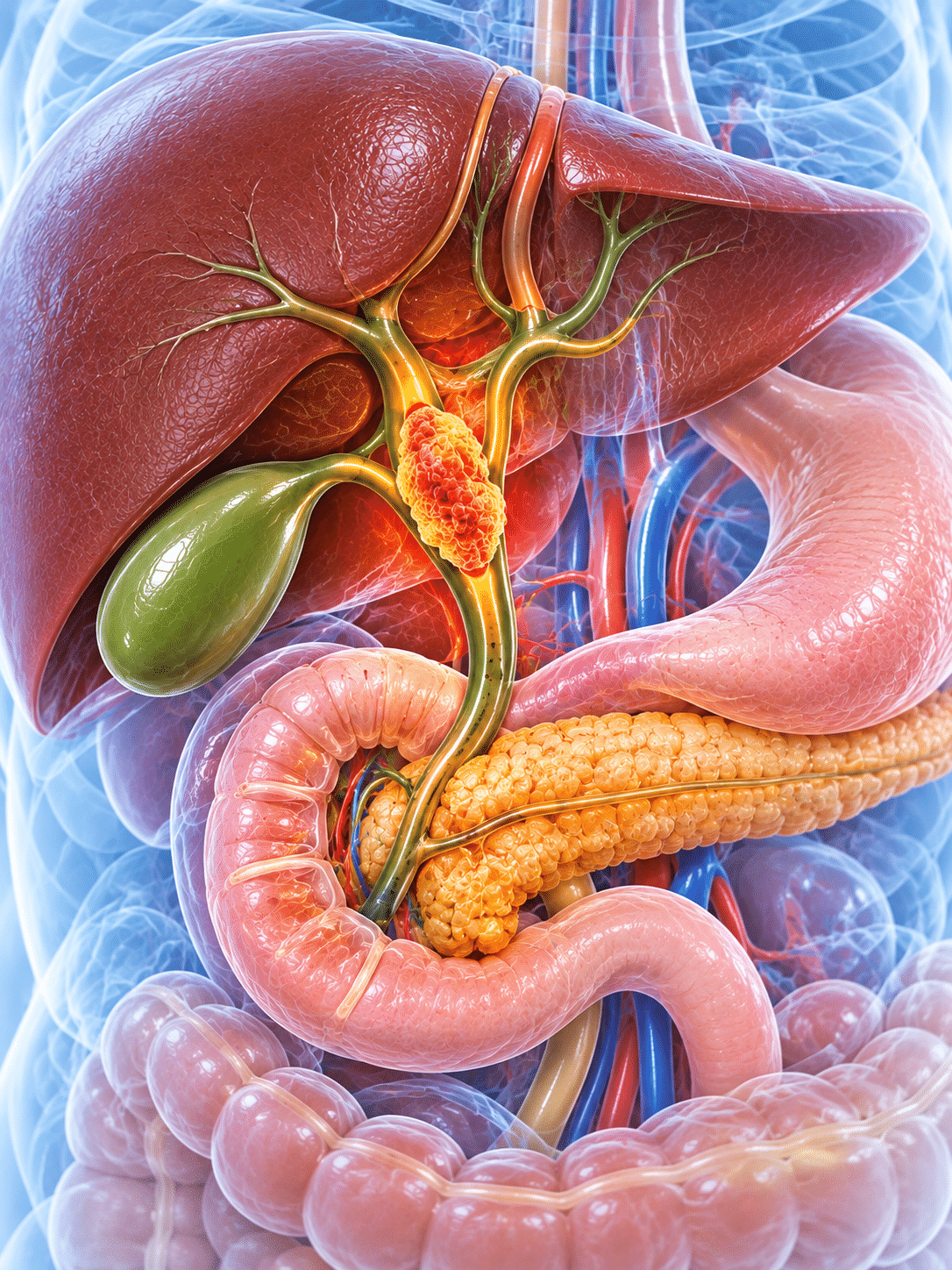
Bile duct cancer, also known as cholangiocarcinoma, develops from abnormal cells in the bile ducts. The bile ducts form a network that carries bile from the liver and gallbladder toward the small intestine.
Because bile ducts are located close to important blood vessels, the liver, pancreas and other structures, surgery can be complex. The treatment approach depends greatly on the anatomical location of the tumour.
Bile duct cancers are generally classified according to whether they arise inside the liver or outside it.
Intrahepatic, perihilar and distal bile duct cancers can require substantially different operations. Accurate imaging and staging are therefore important before treatment is planned.
The location of the tumour within the biliary system influences symptoms, staging and the type of surgery that may be considered.
Develops in bile ducts located within the liver and may require partial liver resection when the disease is surgically removable.
Develops near the area where the right and left hepatic ducts leave the liver. It is also known as a hilar or Klatskin tumour.
Develops farther down the common bile duct, closer to the pancreas and small intestine.
Refers to cancers arising in bile ducts outside the liver, including perihilar and distal tumours.
Small and larger bile ducts within the liver collect bile and connect with the larger hepatic ducts.
These ducts carry bile from the right and left sides of the liver and join to form the common hepatic duct.
Carries bile away from the liver and joins the cystic duct before continuing toward the common bile duct.
Carries bile toward the small intestine and passes close to the pancreas before entering the intestine.
Symptoms can occur when a tumour interferes with the normal flow of bile. These symptoms can also have causes other than cancer.
Yellowing of the skin or whites of the eyes can occur when bile flow is obstructed.
Changes in urine colour may occur when bilirubin levels increase because of impaired bile drainage.
Bile flow obstruction can sometimes cause significant itching.
Persistent abdominal discomfort or pain may occur with bile duct disease.
Fever may occur, particularly when bile duct obstruction is associated with infection.
Unintentional weight loss can occur with bile duct cancer and warrants appropriate evaluation.
Imaging and laboratory investigations help identify the tumour, define its location and assess whether surgical removal may be possible.
Blood tests can provide information about liver function and possible bile duct obstruction.
Ultrasound can help identify bile duct dilatation and other abnormalities within the hepatobiliary system.
CT imaging can help assess the primary tumour, surrounding structures and possible spread.
MRI and magnetic resonance cholangiopancreatography can provide detailed images of the liver and bile duct system.
One of the most important parts of treatment planning is determining whether the tumour can be completely removed with surgery.
When imaging and staging indicate that the tumour can be completely removed, surgery may be considered as part of a potentially curative treatment plan.
When the tumour has spread too extensively or cannot be safely removed completely, systemic or palliative treatment may be considered.
Intrahepatic cholangiocarcinoma develops in bile ducts within the liver. For selected resectable tumours, surgery may involve removing the part of the liver containing the cancer.
The extent of liver resection depends on tumour size, location, involvement of surrounding structures and the amount of healthy liver that can safely remain.
Liver resection may involve removal of a segment, wedge, section or lobe of the liver depending on the location and extent of the tumour.
Perihilar tumours develop near the junction where the right and left hepatic ducts leave the liver. Surgery can therefore involve multiple structures around the liver hilum.
The affected portion of the bile duct may be removed as part of the cancer operation.
Part of the liver may need to be removed to achieve appropriate cancer clearance.
Selected perihilar tumours may require removal of the caudate lobe as part of an extended resection.
Regional lymph nodes may be removed and examined to determine the extent of disease.
Distal bile duct cancers develop closer to the pancreas and small intestine. Because of this location, removing the tumour may require surgery involving the bile duct, pancreas and duodenum.
A pancreaticoduodenectomy, commonly called the Whipple procedure, may be considered for selected patients with resectable distal bile duct cancer.
The Whipple procedure is a complex operation used for selected cancers in the distal bile duct and nearby structures. The exact extent of surgery depends on tumour location and involvement.
The operation is selected according to the anatomical location and extent of the cancer.
Selected small tumours limited to the bile duct may be treated with removal of the affected duct and regional lymph nodes.
Intrahepatic and selected perihilar cancers may require removal of part of the liver.
Perihilar cancers may require combined bile duct and liver surgery with lymph node assessment.
Selected distal bile duct cancers may require a pancreaticoduodenectomy.
Bile duct tumours can block the normal flow of bile and may cause jaundice, itching and other symptoms. In selected patients, restoring bile drainage becomes an important part of treatment.
Depending on the location of the blockage and the overall treatment plan, biliary drainage or stent placement may be considered.
Endoscopic or percutaneous drainage techniques may be used in appropriate situations to relieve biliary obstruction and improve bile flow.
When bile duct cancer cannot be completely removed, treatment focuses on controlling the disease, relieving obstruction and managing symptoms.
If the tumour blocks bile flow, stenting or biliary drainage may help relieve jaundice and other symptoms.
Advanced bile duct cancer may be treated with systemic chemotherapy and, for selected patients, immunotherapy or targeted therapy.
Depending on stage and resectability, surgery may be combined with additional cancer treatments or replaced by non-surgical approaches.
Chemotherapy may be used after surgery in selected patients or as systemic treatment for unresectable or metastatic disease.
Radiation therapy may be used in selected situations for local control or symptom relief.
Selected advanced bile duct cancers may be evaluated for targeted treatments based on tumour characteristics.
Immunotherapy may be considered for selected patients with unresectable or advanced disease.
Because bile duct tumours can involve the liver, bile ducts, blood vessels and nearby organs, detailed treatment planning is important.

Dr. Nitin Singhal is a surgical oncologist in Ahmedabad with experience in the surgical management of gastrointestinal and other cancers.
His areas of surgical oncology include gastrointestinal cancer surgery, hepatobiliary procedures, colorectal cancer surgery, robotic cancer surgery, HIPEC and other complex cancer procedures.
Bile duct cancer, also known as cholangiocarcinoma, is a rare cancer arising from the biliary system. It can develop inside the liver or in the extrahepatic bile ducts around the liver hilum and common bile duct.
Treatment depends strongly on the tumour's anatomical location. Intrahepatic cholangiocarcinoma may require liver resection, while selected perihilar cancers may require combined bile duct and liver surgery. Distal bile duct cancers may require a Whipple procedure.
For selected resectable cancers, complete surgical removal is an important treatment option. The exact procedure depends on the tumour's relationship with the liver, bile ducts, blood vessels, lymph nodes and nearby organs.
When the cancer cannot be completely removed, treatment may include biliary stenting or drainage, chemotherapy, radiation, targeted therapy or immunotherapy depending on the individual clinical situation.
If you have been diagnosed with bile duct cancer or cholangiocarcinoma, a specialist evaluation can help clarify the tumour's location, stage, resectability and available treatment options.
Bile duct cancer, or cholangiocarcinoma, is a cancer that develops in the bile ducts. It can arise within the liver, near the liver hilum or farther down the common bile duct.
Bile duct cancer is generally classified as intrahepatic, perihilar or distal cholangiocarcinoma based on the location of the tumour.
Surgery may be considered when the cancer can be completely removed and the patient is medically fit for the operation. The type of surgery depends on the tumour's location and extent.
Selected resectable intrahepatic bile duct cancers may be treated with partial hepatectomy or another liver resection designed to remove the tumour with appropriate margins.
Perihilar cholangiocarcinoma develops near the area where the right and left hepatic ducts leave the liver. It is also called a hilar or Klatskin tumour.
A Whipple procedure may be used for selected resectable distal bile duct cancers because these tumours are located close to the pancreas and small intestine.
Bile duct obstruction can cause jaundice and other symptoms. Depending on the situation, an endoscopic stent or percutaneous biliary drainage may be used to restore bile flow.
Yes. Chemotherapy may be used after surgery in selected patients or as systemic treatment for unresectable, metastatic or recurrent bile duct cancer.
Immunotherapy may be considered for selected patients with advanced or unresectable bile duct cancer. Suitability depends on the clinical and molecular characteristics of the disease.
Complete surgical removal offers the potential for cure in selected resectable cases. However, many bile duct cancers are diagnosed at an advanced stage, so the appropriate treatment and expected outcome vary considerably between patients.
Get a personalised evaluation to understand your diagnosis, tumour location, stage, surgical options and whether cancer surgery may be appropriate for your condition.

Dr. Nitin Singhal has been recognised for his contribution to cancer care and surgical oncology, reflecting his commitment to advanced surgical techniques, clinical excellence and patient-centred care.
Surgical oncology training from Tata Memorial Hospital, Mumbai.
Expertise across complex and multidisciplinary cancer surgery.
Honoured for excellence in healthcare and surgical oncology.
Focus on evidence-based and personalised cancer treatment.
Recognition that reflects a continued commitment to excellence in cancer care.

