Comprehensive evaluation and treatment planning for soft tissue sarcoma, with management tailored according to tumour type, location, size, grade, stage and relationship with nearby structures.
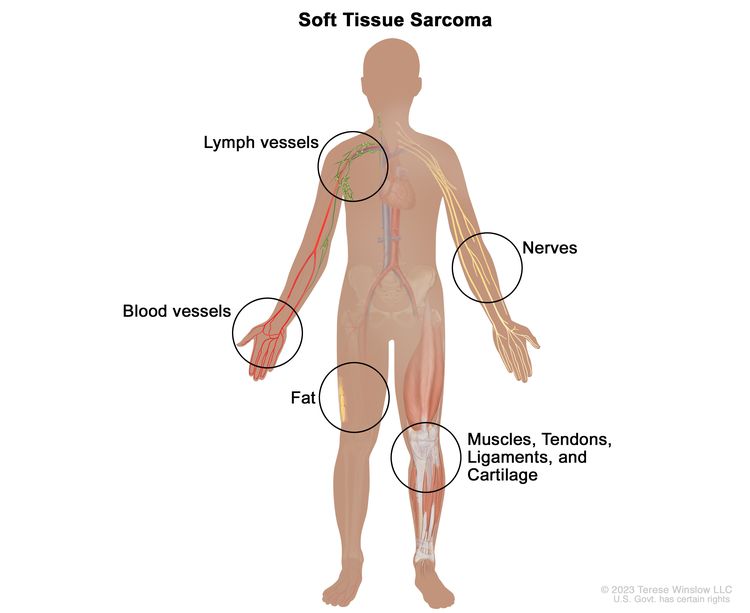
Soft tissue sarcoma is a broad group of cancers that begin in the body's soft tissues. These include muscle, fat, tendons, blood vessels, lymphatic vessels, nerves and connective tissues.
Soft tissue sarcomas can develop in almost any part of the body. They are commonly found in the arms, legs, chest and abdomen, but can occur in many other anatomical locations.
There are many different subtypes of soft tissue sarcoma. Their behaviour and treatment can vary significantly, making accurate pathology and staging particularly important.
Soft tissue sarcoma is not one single disease. Treatment depends on the specific histological subtype, tumour grade, size, location and stage.
Sarcomas can develop in different types of soft tissue throughout the body.
Extremity sarcomas can arise in muscles, connective tissues, blood vessels or other soft tissues of the limbs.
Tumours may develop in the chest wall, shoulder region, abdominal wall or other soft tissues of the trunk.
Soft tissue sarcomas can develop deep within the abdomen or pelvis and may involve surrounding organs or structures.
Sarcomas can also arise in soft tissues of the head and neck, where treatment requires careful consideration of nearby structures.
A sarcoma arising from fat tissue. Different subtypes of liposarcoma can have different patterns of growth and treatment.
A malignant tumour arising from smooth muscle cells and capable of developing in different parts of the body.
A high-grade sarcoma that can arise in the limbs, trunk and other soft tissue locations.
A distinct sarcoma that commonly occurs near joints, although it can develop in other locations.
A sarcoma that often develops in the extremities, particularly in older adults.
Other subtypes include angiosarcoma, malignant peripheral nerve sheath tumour, epithelioid sarcoma and several rare entities.
Soft tissue sarcoma may initially appear as a painless lump or swelling.
A lump that continues to increase in size should be evaluated, particularly when it is deep or progressively enlarging.
A swelling beneath the skin or deep within muscle can sometimes represent a soft tissue tumour.
Pain may occur when a tumour grows and presses against nerves, muscles or other nearby structures.
Tumours near joints or muscles can interfere with movement or normal limb function.
Sarcomas developing in the abdomen can cause fullness, discomfort, pain or pressure depending on their size and location.
Tumours near nerves may cause pain, numbness, weakness or other neurological symptoms.
Most soft tissue lumps are not sarcomas, but certain features warrant appropriate imaging and specialist assessment.
A lump that continues to grow should be assessed rather than repeatedly observed without investigation.
A mass located deep within muscle or beneath the fascia may need imaging and specialist assessment.
Larger soft tissue masses require appropriate evaluation to determine their nature and extent.
A mass that persists or returns after apparently benign treatment may require further investigation.
Diagnosis begins with appropriate imaging of the suspicious mass. MRI is particularly useful for many extremity and soft tissue tumours, while CT may be used for other anatomical locations.
A biopsy is then performed when appropriate to determine whether the lesion is malignant and to identify the specific sarcoma subtype and grade.
Biopsy planning is important. The biopsy tract should be planned with the treating sarcoma team so that it can be removed during definitive surgery if required.
A biopsy should be carefully planned because its location can affect subsequent surgical treatment.
The mass is assessed for size, depth, mobility, tenderness and relationship to surrounding structures.
MRI can provide detailed information about the size, depth and local extent of many soft tissue tumours.
Image-guided core needle biopsy is commonly used to obtain tissue for diagnosis.
CT and, in selected circumstances, PET imaging can help evaluate the primary tumour and possible spread.
Soft tissue sarcomas include many different tumour subtypes, so accurate pathological classification is central to treatment planning.
Pathology identifies the specific type of sarcoma and distinguishes it from other soft tissue tumours.
Tumour grade reflects how abnormal the cells appear and how quickly they are dividing. Higher-grade tumours generally behave more aggressively.
Selected sarcoma subtypes may require immunohistochemistry or molecular testing to confirm the diagnosis.
Because sarcomas can be difficult to classify, specialist pathological review can be important before definitive treatment.
Staging considers the characteristics of the primary tumour, lymph nodes, distant spread and tumour grade.
Tumour size, depth and anatomical location are assessed.
Pathological grade provides information about tumour biology and potential aggressiveness.
Regional lymph-node involvement is uncommon overall but can occur more frequently with selected sarcoma subtypes.
Imaging evaluates whether the cancer has spread to distant organs, particularly the lungs.
Complete surgical removal with appropriate margins is the mainstay of treatment for many localized soft tissue sarcomas.
The tumour is removed together with a margin of surrounding tissue to achieve complete resection where feasible.
The surgical specimen is examined to determine whether tumour cells remain at the edges of the removed tissue.
Surgery aims to remove the tumour while preserving important nerves, blood vessels, muscles and other functional structures when oncologically appropriate.
Reconstructive techniques can sometimes help restore soft tissue coverage and function after extensive tumour removal.
For many sarcomas of the arms and legs, treatment can focus on removing the tumour while preserving the limb and its function.
Limb-sparing surgery removes the tumour with an appropriate oncological margin while attempting to preserve the function and appearance of the affected limb.
Depending on the tumour's location and relationship to nerves, blood vessels, bone and muscle, additional reconstructive surgery may be required.
Radiation therapy and, in selected situations, chemotherapy may be used before or after surgery as part of a combined treatment plan.
Modern sarcoma treatment often aims for complete tumour removal while preserving useful limb function when this can be achieved safely.
Amputation is now rarely required for soft tissue sarcoma but can be considered in carefully selected situations.
If a tumour cannot be completely removed while preserving a functional limb, or if critical structures are extensively involved, amputation may occasionally be considered.
The decision depends on tumour extent, involvement of major nerves or blood vessels, bone involvement, previous treatment and expected limb function.
Whenever possible, limb-sparing treatment is evaluated before considering such extensive surgery.
NCI notes that amputation is rarely used for soft tissue sarcoma and is generally reserved for selected extensive cases.
Radiation can be used before or after surgery to improve local control in selected soft tissue sarcomas.
Radiation may be given before surgery in selected tumours to help control the local disease and support a planned resection.
Postoperative radiation may be recommended when the risk of local recurrence is considered significant.
High-dose radiation may be considered when surgery cannot be performed or would cause unacceptable morbidity in selected cases.
Radiation can also be used to control symptoms from selected unresectable or metastatic tumours.
The role of chemotherapy varies considerably between soft tissue sarcoma subtypes and stages.
Chemotherapy is an important systemic treatment option for selected advanced or metastatic soft tissue sarcomas.
Neoadjuvant chemotherapy may be considered in selected cases, particularly when tumour shrinkage could facilitate surgery.
Adjuvant chemotherapy may be considered in selected higher-risk patients, although its role is not established for every sarcoma.
Chemotherapy sensitivity varies among sarcoma subtypes, so the pathological diagnosis is important when selecting systemic therapy.
Selected sarcoma subtypes may be considered for targeted or immune therapies based on tumour biology and previous treatment.
Targeted medicines may be appropriate for selected sarcoma subtypes or molecular characteristics.
Certain tyrosine kinase inhibitors are used for selected advanced soft tissue sarcomas.
Immune checkpoint inhibitors are being used or studied in selected sarcoma subtypes and treatment settings.
Clinical trials can provide access to emerging targeted and immunotherapy approaches for selected patients.
Retroperitoneal sarcomas develop in the deep tissues behind the abdominal cavity. They can become large before causing symptoms because there is considerable space for growth.
Surgical treatment can be complex because these tumours may lie close to or involve major blood vessels, kidneys, bowel and other abdominal structures.
Treatment planning should therefore be undertaken by a multidisciplinary team with experience in complex sarcoma surgery.
The anatomical location of retroperitoneal sarcomas can require carefully planned multivisceral surgery in selected patients.
Lymph-node spread is uncommon overall but occurs more often with certain sarcoma subtypes.
Many adult soft tissue sarcomas more commonly spread through the bloodstream rather than regional lymph nodes.
Synovial sarcoma, epithelioid sarcoma, clear cell sarcoma and some vascular sarcomas have a greater tendency toward lymph-node spread.
Removal of regional lymph nodes may be considered when clinically involved nodes are present or for selected tumour types.
Lymph-node status is incorporated into staging when regional nodal disease is present.
The lungs are a common site of distant spread, although metastases can occur in other organs depending on the sarcoma subtype.
Systemic chemotherapy may be used for advanced soft tissue sarcoma, depending on histology and previous treatment.
Surgical removal of limited lung metastases may be considered in carefully selected patients.
Certain targeted therapies may be considered according to the sarcoma subtype and prior treatment.
Clinical trials may provide access to new systemic, targeted or immunotherapy approaches.
Treatment of recurrent sarcoma depends on where it has returned, previous treatment and whether the recurrent disease can be removed.
Selected local recurrences may be treated with repeat surgery, radiation or a combination of local treatments.
Limited pulmonary metastases may be evaluated for surgical removal in selected patients.
Chemotherapy, targeted treatment or other systemic approaches may be considered for unresectable or widespread recurrence.
Recurrent sarcoma often requires reassessment by surgical, radiation and medical oncology specialists.
Sarcoma treatment often requires coordination between several specialties before the first procedure is performed.
Evaluates resectability, surgical margins and the possibility of preserving important structures.
Confirms the histological subtype and tumour grade.
Determines whether radiation should be used before or after surgery or for unresectable disease.
Assesses the role of chemotherapy, targeted therapy, immunotherapy or clinical trials.
Treatment is individualised according to the tumour's pathology, anatomy and stage.
MRI, CT or other appropriate imaging is used to understand the tumour's location and extent.
Obtain adequate tissue using a biopsy route planned around future definitive surgery.
Establish the sarcoma subtype and grade through specialist pathological assessment.
Determine the role of surgery, radiation, systemic therapy or combined treatment.

Dr. Nitin Singhal is a surgical oncologist in Ahmedabad with experience in complex cancer surgery and multidisciplinary cancer care.
Soft tissue sarcoma surgery requires careful assessment of the tumour's location, relationship to nerves and blood vessels, surgical margins and the possibility of preserving important function.
Soft tissue sarcoma is a broad group of cancers that develop in soft tissues such as muscle, fat, tendons, blood vessels, lymphatic vessels, nerves and connective tissue. These tumours can occur in the arms, legs, chest, abdomen, pelvis and other areas of the body.
Because there are many different sarcoma subtypes, accurate diagnosis is particularly important. Evaluation can involve MRI, CT or other imaging followed by a carefully planned core needle or incisional biopsy. Pathological review by a sarcoma-experienced pathologist can help establish the tumour subtype and grade.
Surgery is the main treatment for many localized soft tissue sarcomas. Wide local excision with appropriate surgical margins is commonly used, while limb-sparing surgery may be considered for extremity tumours when complete removal can be achieved while preserving useful limb function.
Radiation therapy may be used before or after surgery in selected patients. Chemotherapy has a more selective role and is influenced by tumour subtype, stage and individual risk. Targeted therapy and immunotherapy may also be considered for selected advanced sarcomas.
Advanced or recurrent soft tissue sarcoma may require systemic treatment, radiation, surgery for selected metastatic disease or combinations of these approaches. Treatment is best planned by a multidisciplinary team with experience in sarcoma management.
If you have a growing soft tissue lump or have been diagnosed with soft tissue sarcoma, specialist evaluation can help clarify the diagnosis, stage and appropriate treatment options.
Common questions about soft tissue sarcoma diagnosis, surgery and treatment.
Get a personalised evaluation to understand your diagnosis, sarcoma subtype, tumour stage and available surgical and multidisciplinary treatment options.
Explore specialised cancer treatment and surgical oncology services, organised by area of expertise.
Advanced surgical approaches for selected complex cancers.
Specialised surgical oncology care for women's cancers.
Specialised treatment and surgical care for ovarian cancer.
Comprehensive care for selected gynaecological cancers.
Individualised cervical cancer evaluation and surgical care.
Surgical and multidisciplinary care for uterine cancers.
Specialised surgical care for gastrointestinal cancers.
Cancer care for the urinary system and male reproductive organs.
Comprehensive surgical care for urological cancers.
Specialised surgical treatment for kidney cancer.
Personalised surgical care for prostate cancer.
Evaluation and surgical treatment of testicular cancer.
Diagnosis and surgical management of bladder cancer.
Specialised surgical oncology care for head and neck cancers.
Specialised surgical care for breast cancer.
Specialised cancer care for children and young patients.

Dr. Nitin Singhal has been recognised for his contribution to cancer care and surgical oncology, reflecting his commitment to advanced surgical techniques, clinical excellence and patient-centred care.
Surgical oncology training from Tata Memorial Hospital, Mumbai.
Expertise across complex and multidisciplinary cancer surgery.
Honoured for excellence in healthcare and surgical oncology.
Focus on evidence-based and personalised cancer treatment.
Recognition that reflects a continued commitment to excellence in cancer care.