



A diagnosis of gynaecological cancer can bring many concerns about treatment, surgery and recovery. For women in Ahmedabad and across Gujarat, understanding the available surgical options is an important step towards making informed treatment decisions.
Robotic-assisted surgery is an advanced form of minimally invasive surgery used in selected cases of gynaecological cancers. It allows a trained surgeon to operate using specialised instruments controlled from a console, with the assistance of a magnified, high-definition 3D camera.
Depending on the type and stage of cancer, robotic surgery may offer potential benefits such as smaller incisions, reduced blood loss, less postoperative discomfort and a shorter hospital stay compared with traditional open surgery.
However, robotic surgery is not suitable for every patient or every type of gynaecological cancer.
For patients considering robotic cancer surgery in Ahmedabad, the most important decision is choosing the surgical approach that offers appropriate cancer treatment, patient safety and the best possible outcome.
In this article, we explain how robotic surgery works, which gynaecological cancers may be treated using this approach, its potential benefits and risks, and what patients should expect during recovery.
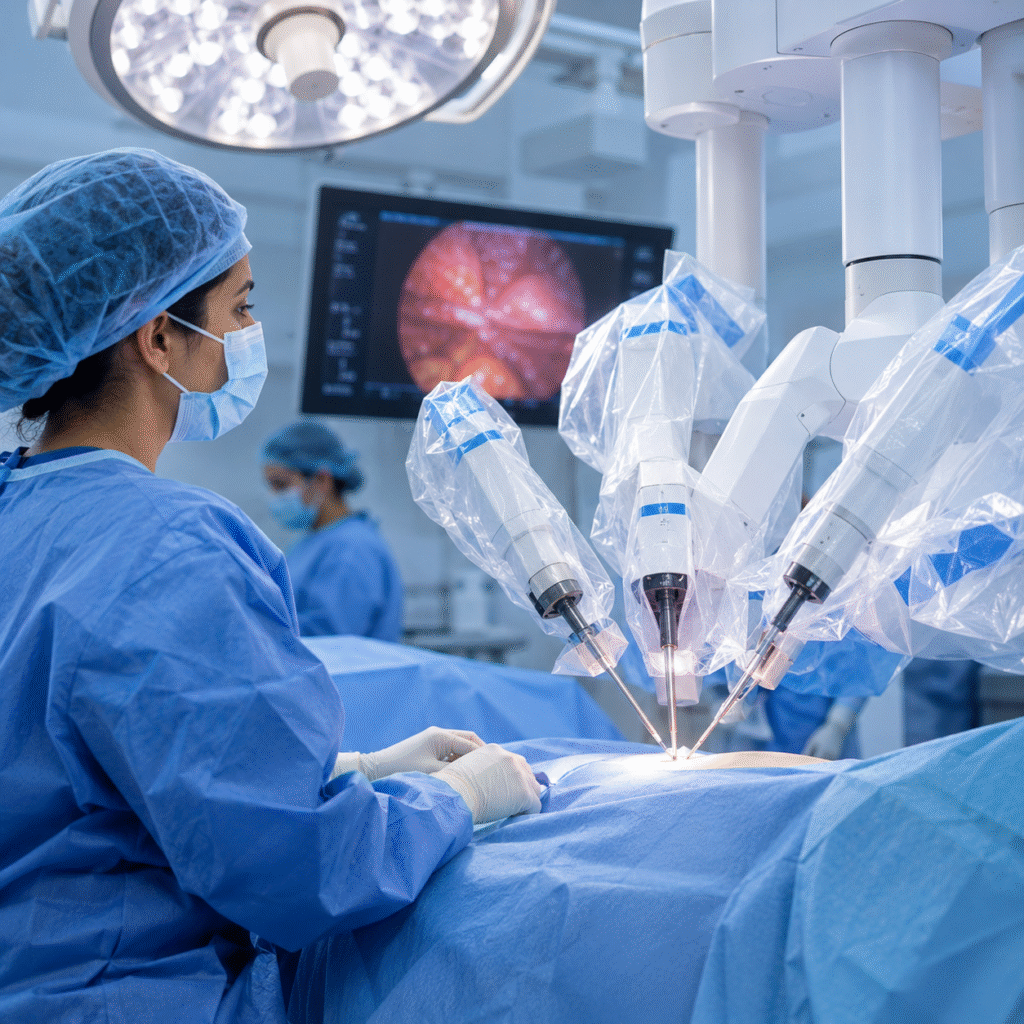
Robotic-assisted surgery is an advanced form of minimally invasive surgery used to perform selected operations involving the female reproductive organs.
The surgeon operates from a specialised console and controls robotic instruments attached to small surgical arms. A high-definition 3D camera provides a magnified view of the surgical area, helping the surgeon visualise delicate structures and perform controlled movements.
Depending on the patient's condition, the procedure may involve removing cancer-affected tissue, the uterus, ovaries, fallopian tubes or nearby lymph nodes.
An important point: Robotic surgery is not performed independently by a machine. The surgeon controls every movement of the robotic instruments throughout the operation.
For women exploring gynaecological cancer treatment in Ahmedabad, understanding this distinction can help them evaluate the role of robotic technology in their treatment plan.
Robotic-assisted surgery may be considered for selected patients with different types of gynaecological cancers. The appropriate approach depends on the cancer type, stage, tumour characteristics and the operation required.
Endometrial cancer develops in the lining of the uterus. Surgery is an important treatment for many patients, particularly when the disease is confined to the uterus.
For appropriately selected patients, robotic surgery may be used to remove the uterus, fallopian tubes and ovaries, and assess nearby lymph nodes when indicated.
Cervical cancer develops in the cervix, the lower part of the uterus. Surgical treatment depends on the stage, tumour characteristics and individual treatment plan.
Although robotic techniques have been used for selected cervical cancer procedures, minimally invasive radical hysterectomy is not appropriate for every patient. Evidence from the LACC trial showed poorer cancer outcomes with minimally invasive radical hysterectomy compared with open surgery in early-stage cervical cancer.
Therefore, the surgical approach must be selected carefully according to current evidence and specialist recommendations.
Ovarian cancer develops in one or both ovaries. Treatment often involves surgery, chemotherapy or a combination of both.
Robotic surgery may have a role in selected early-stage cases, diagnostic procedures or certain carefully selected surgical situations. However, extensive ovarian cancer surgery often requires an open approach, particularly when widespread disease needs to be removed.
The treatment decision depends on the extent of cancer and whether complete removal of visible disease can be achieved safely.
Before recommending robotic-assisted surgery, the treating team evaluates the patient's diagnosis, imaging reports, cancer stage and overall health.
The general steps include:
The patient is given general anaesthesia so that she remains asleep and does not experience pain during the operation.
The surgeon makes several small incisions in the abdomen to introduce the camera and specialised robotic instruments.
The surgeon sits at a console and controls the instruments while viewing a magnified 3D image of the operating area. The robotic system translates the surgeon's hand movements into controlled instrument movements.
Depending on the cancer, the surgeon removes the required organs, tissues or lymph nodes according to the planned oncological procedure.
The instruments are removed, the small incisions are closed and the patient is shifted to the recovery area for observation.
The exact procedure varies depending on the cancer type and surgical objective.
When robotic surgery is appropriate, its minimally invasive approach may offer several potential advantages compared with traditional open surgery.
Robotic surgery is performed through small incisions rather than one large abdominal incision. This may result in smaller scars and less wound-related discomfort.
The magnified surgical view and controlled instrument movements may help the surgeon identify and manage blood vessels during the procedure. This can reduce blood loss in appropriately selected operations.
Smaller incisions may result in less pain and a reduced need for pain medication compared with some open procedures.
Many patients undergoing minimally invasive gynaecological surgery can leave the hospital sooner than patients undergoing comparable open procedures. The actual hospital stay depends on the complexity of the operation and individual recovery.
Some patients may return to routine activities sooner because the abdominal incisions are smaller and recovery may be less demanding than after open surgery.
The high-definition 3D camera provides a magnified view of the operating area. Wristed robotic instruments also allow controlled movements in confined anatomical spaces.
These features can help surgeons perform certain complex procedures with greater instrument flexibility.
For patients exploring advanced cancer surgery in Ahmedabad, it is important to understand that these advantages are potential benefits, not guaranteed outcomes. Results depend on the cancer, surgical procedure, surgeon's experience and individual health factors.
No. Robotic surgery is not the right choice for every patient.
The decision depends on several important factors:
For example, robotic surgery may be suitable for selected patients with uterine-confined endometrial cancer, while open surgery may be preferred for certain cervical and advanced ovarian cancer procedures.
Patients seeking gynaecological cancer treatment in Ahmedabad should discuss why a particular surgical approach is recommended and what alternatives are available.
Recovery varies depending on the type of cancer, extent of surgery and the patient's general health.
However, patients generally go through the following stages.
Patients are monitored after surgery. The medical team checks vital signs, pain levels, wound healing and the ability to eat, drink and move around.
Early walking is usually encouraged when medically appropriate to support recovery and reduce the risk of blood clots.
Patients gradually resume light daily activities as advised by their medical team.
Some tiredness, mild abdominal discomfort and temporary changes in bowel or bladder function may occur, depending on the procedure.
Activity levels are increased gradually. Patients may return to work and other routine activities when their surgeon confirms that recovery is progressing appropriately.
Recovery after cancer surgery may take longer if additional procedures or postoperative treatment are required.
Patients travelling to Ahmedabad from other parts of Gujarat or India for cancer treatment should also discuss their expected hospital stay, follow-up schedule and travel arrangements with the treating team before surgery.
Like every major operation, robotic-assisted surgery carries potential risks.
These may include:
The possibility of complications depends on the patient's condition and the complexity of surgery.
Patients should discuss the potential risks, expected outcomes and available alternatives with their surgeon before making a treatment decision.
| Feature | Robotic-Assisted Surgery | Open Surgery |
|---|---|---|
| Incisions | Usually several small incisions | Usually one larger incision |
| Surgical view | Magnified 3D camera | Direct surgical view |
| Blood loss | May be lower in selected procedures | May be higher in some procedures |
| Postoperative pain | Often less | Often more |
| Hospital stay | Often shorter | Often longer |
| Recovery | May be faster | May take longer |
This is a general comparison. The most appropriate approach depends on the cancer type, stage, surgical requirements and the surgeon's assessment. Conventional laparoscopic surgery is also an important minimally invasive alternative.
Choosing a suitable specialist and understanding the treatment plan are important parts of cancer care.
If you are considering robotic surgery for a gynaecological cancer in Ahmedabad, Gujarat, discuss the following points with your treating team:
For patients travelling from other cities in Gujarat or elsewhere in India, it may also help to plan investigations, consultations and postoperative follow-up in advance.
The aim is to make a well-informed treatment decision based on medical evidence and individual needs.
Robotic-assisted surgery is used for selected gynaecological cancer procedures at centres with the required technology and trained surgical teams. Availability and suitability should be confirmed with the treating hospital and specialist.
Robotic-assisted surgery can be an appropriate option for selected gynaecological cancer procedures when performed by a suitably trained surgical team. Safety depends on the cancer type, stage, procedure and surgeon's experience.
The duration varies according to the type and complexity of surgery. Procedures involving lymph node assessment or extensive tissue removal may take longer than simpler operations.
Some patients may be discharged within one or two days after selected minimally invasive procedures. More complex operations may require a longer hospital stay.
The goal of cancer surgery is to remove the disease according to the planned oncological treatment. Whether all visible cancer can be removed depends on its location, stage and extent. Robotic technology does not guarantee complete cancer removal.
Both are minimally invasive approaches. Robotic surgery provides 3D visualisation and wristed instruments, while conventional laparoscopy uses rigid instruments. Neither approach is automatically better for every patient. The choice depends on the procedure and the surgeon's expertise.
Some patients may require chemotherapy, radiation therapy or other additional treatments after surgery. This depends on the cancer type, stage, pathology results and individual treatment plan.
Patients from different parts of Gujarat and India may seek specialist consultations and treatment in Ahmedabad. They should discuss medical records, investigations, hospital arrangements and postoperative follow-up with the treating team before travelling.
Many patients gradually resume light activities within the first few weeks. The timing of returning to work, exercise and other activities should be guided by the treating surgeon.
Robotic-assisted surgery has expanded the possibilities of minimally invasive treatment for selected gynaecological cancers. With advanced visualisation and specialised surgical instruments, it can help trained surgeons perform certain complex procedures through smaller incisions.
However, the choice of surgery should always be based on cancer control, patient safety and the expected benefits of treatment.
For women in Ahmedabad, Gujarat and across India, understanding the available treatment options and receiving an individual assessment from an appropriately qualified specialist are important steps in planning cancer care.
If you or a family member has been diagnosed with a gynaecological cancer, consult a qualified specialist to understand the available treatment options and whether robotic-assisted surgery is appropriate for your specific condition.
The right surgical approach is not necessarily the most advanced one. It is the one that offers the most appropriate balance of cancer control, safety, recovery and quality of life.
Dr. Nitin Singhal is a surgical oncologist based in Ahmedabad, Gujarat, with a focus on cancer surgery, including robotic-assisted and advanced surgical procedures.
Patients seeking guidance about cancer surgery can discuss their diagnosis, treatment options and suitability for advanced surgical approaches during a specialist consultation.
Website: https://drnitinsinghal.com/
Medical Disclaimer: This article is intended for educational purposes only. It does not replace an individual medical consultation, diagnosis or treatment recommendation. The suitability of robotic surgery must be evaluated by a qualified specialist based on the patient's specific medical condition.


