



“Doctor, is robotic surgery really better, or is it just expensive?”
As a surgical oncologist, I hear this question regularly. Patients and their families want to understand whether robotic-assisted surgery offers meaningful benefits or whether conventional surgery would be just as effective.
It is an important question, and it deserves an honest answer.
Robotic-assisted surgery has changed the way certain complex operations are performed. In appropriately selected patients, it can help surgeons operate through small incisions with enhanced visualisation and precise instrument control. Depending on the procedure, these advantages may contribute to less surgical trauma, a shorter hospital stay and a smoother recovery.
But there is one thing every patient should understand: the robot does not make the surgical decisions. The surgeon does.
The technology is a tool. The surgeon's training, judgement, experience and understanding of the cancer remain central to the treatment.
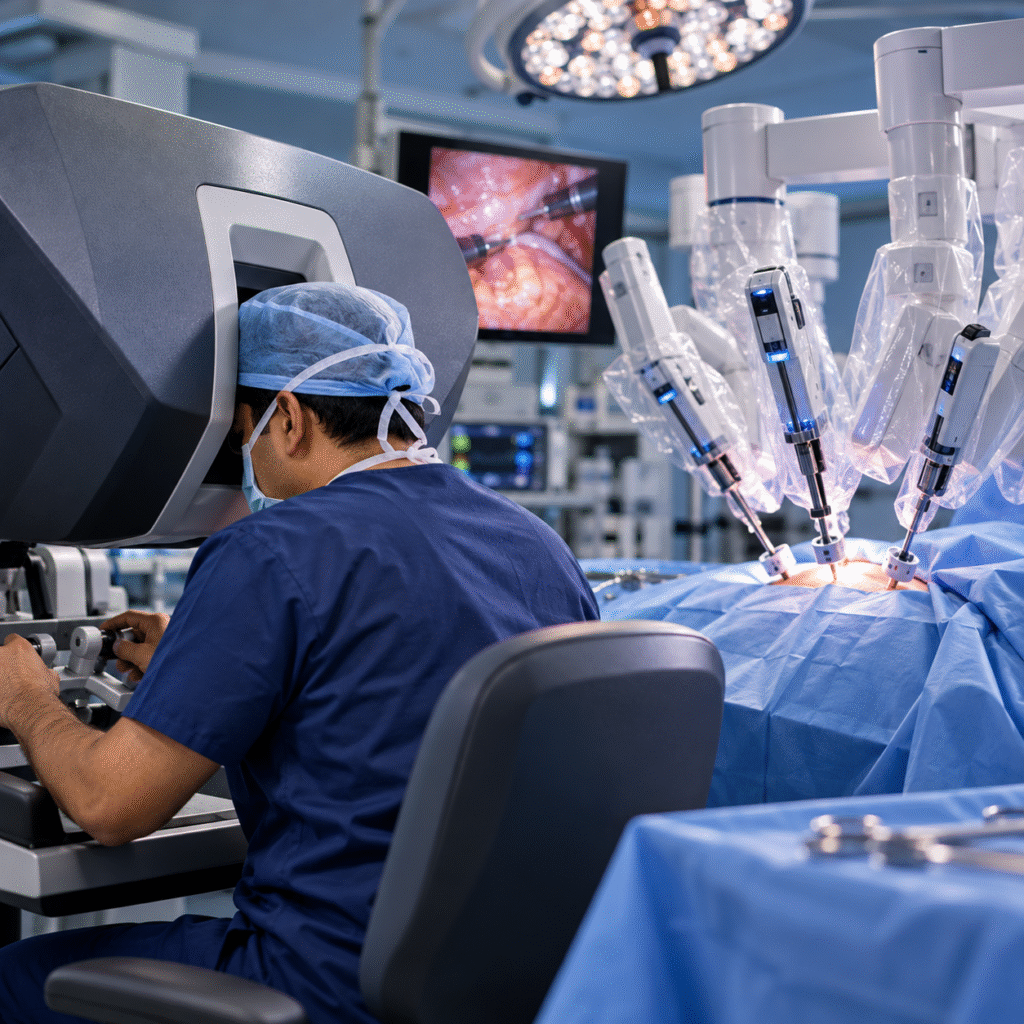
Robotic cancer surgery is a form of minimally invasive surgery in which a trained surgeon operates specialised instruments using a robotic-assisted surgical system.
Unlike a traditional open operation, which may require a larger incision, robotic-assisted procedures are generally performed through several small incisions. A camera provides a magnified, three-dimensional view of the surgical area, while specialised instruments allow the surgeon to perform carefully controlled movements.
The surgeon remains in control of the instruments throughout the operation. The robotic system translates the surgeon's hand movements into instrument movements inside the patient's body.
It is important to understand that robotic surgery is not an autonomous operation. The robot does not independently identify cancer, decide how much tissue to remove or determine the best treatment approach.
Those decisions belong to the surgical team.
The main differences relate to how the surgeon accesses the operating area, visualises the anatomy and manipulates surgical instruments.
Many robotic-assisted operations are performed through small incisions rather than the larger incision required for some open procedures.
Smaller incisions may reduce wound-related discomfort and help patients return to routine activities sooner. However, the benefits depend on the specific operation, the patient's health and whether the procedure can be completed safely using a minimally invasive approach.
Robotic surgical systems can provide magnified, three-dimensional views of the operating area.
This can help surgeons identify anatomical structures and work in confined spaces. The benefit may be particularly relevant in selected complex procedures where precision and access are important.
Robotic instruments are designed to provide a wide range of controlled movements within the body.
This can make certain surgical tasks easier to perform in anatomically restricted areas. However, the technology does not replace the need for sound surgical technique, careful planning and appropriate training.
Depending on the operation, robotic-assisted surgery may be associated with less postoperative pain, reduced blood loss, shorter hospitalisation and an earlier return to daily activities compared with some open procedures.
These benefits are not guaranteed. Outcomes vary between patients and procedures, and robotic surgery is not automatically superior to every conventional or laparoscopic approach.
This is one of the most important questions patients should ask.
In cancer surgery, the objective is not simply to make smaller incisions. The priority is to remove the cancer appropriately while protecting surrounding structures and achieving the best possible outcome for the patient.
For selected cancers, robotic-assisted surgery can provide a minimally invasive way to perform complex operations. Its suitability depends on the type of cancer, its location and extent, the patient's overall health and the surgeon's expertise.
The evidence also varies by cancer type and procedure. In some situations, robotic surgery offers meaningful advantages. In others, conventional laparoscopy or open surgery may be equally appropriate or preferable.
A robotic approach should never be chosen solely because it uses advanced technology.
The right operation is the one that provides appropriate cancer treatment for the individual patient—not necessarily the one that uses the newest equipment.
Recovery is one of the most common concerns for patients preparing for cancer surgery.
Some patients undergoing minimally invasive cancer operations may be discharged within a few days, while recovery after certain open procedures can require a longer hospital stay.
However, these timeframes cannot be applied to every operation.
Recovery depends on several factors, including:
The goal is not simply to send a patient home earlier. It is to ensure that the patient is medically stable, comfortable enough to manage at home and supported by an appropriate follow-up plan.
Cost is a legitimate concern, particularly when families are already dealing with the financial and emotional burden of a cancer diagnosis.
Robotic-assisted surgery may cost more than some conventional approaches because of equipment, maintenance, specialised instruments, operating-room requirements and other hospital charges.
However, the overall cost depends on the hospital, the procedure, the patient's clinical circumstances and the services included in the treatment package.
When comparing options, patients should ask for a clear breakdown of the expected expenses.
It is also worth discussing whether differences in hospital stay, recovery or postoperative care could affect the overall cost. Such savings are not guaranteed and should not be assumed to offset the additional expense of robotic surgery.
The most expensive option is not automatically the best option, and the least expensive option is not necessarily the most appropriate.
The decision should balance clinical suitability, expected outcomes, potential benefits, risks and affordability.
Robotic-assisted techniques are used for selected operations across several surgical specialties. In surgical oncology, their role depends on the tumour's characteristics, the operation required and the treating team's expertise.
Depending on the individual case and available expertise, robotic-assisted surgery may be considered for procedures involving:
Robotic-assisted prostate surgery may be an option for selected patients who require surgical removal of the prostate. Treatment decisions depend on the stage and risk category of the cancer, the patient's health and the available alternatives.
Robotic-assisted surgery may be suitable for certain operations involving gynaecological cancers, including selected cases of uterine cancer. The appropriate approach depends on the disease's extent and the treatment plan.
Some patients with colon or rectal cancer may be candidates for minimally invasive surgery, including robotic-assisted procedures. The decision depends on tumour location, disease extent and the operation required.
Robotic-assisted techniques may be used in selected kidney and other urological operations. The aim may be to remove the tumour while preserving healthy tissue where clinically appropriate.
Robotic systems may also be used for certain operations involving other parts of the gastrointestinal tract and selected complex surgical conditions.
Not every cancer can or should be treated robotically. The availability of the technology does not itself establish that it is the best option for a particular patient.
Like every surgical approach, robotic-assisted surgery has limitations.
Potential concerns include higher treatment costs, the availability of appropriately trained surgeons, longer operating times in some circumstances and the possibility that an operation may need to be converted to an open procedure.
Robotic surgery also carries the usual risks associated with major operations and anaesthesia, including bleeding, infection, injury to nearby structures and other procedure-specific complications.
The risks vary according to the operation and the patient's health.
Patients should discuss the expected benefits and risks of robotic surgery alongside those of laparoscopic and open surgery. They should also ask about the surgeon's experience with the specific procedure and the team's plan for managing complications.
Absolutely not.
A robotic surgical system provides the surgeon with specialised instruments and visualisation. It does not replace clinical judgement, surgical experience or responsibility for the patient's care.
The surgeon must interpret the findings, plan the operation, identify the relevant anatomical structures and make decisions throughout the procedure.
A well-trained surgeon also needs to recognise when a robotic approach is unsuitable and when another surgical technique would be safer or more appropriate.
Technology can expand a surgeon's capabilities, but it cannot compensate for poor treatment planning or replace the fundamentals of good cancer care.
If you or a family member has been advised to undergo cancer surgery, consider asking the treating surgeon these questions:
These questions can help you make a more informed decision and understand why a particular approach has been recommended.
Robotic-assisted surgery is an important advancement in modern surgical care. For appropriately selected patients, it can offer useful technical advantages and may improve aspects of recovery compared with certain other approaches.
But it is not a universal solution, and it is not automatically better simply because a robot is involved.
As a surgical oncologist, I believe the most important decision is choosing the right treatment for the right patient. That means considering the cancer, the patient's health, the available evidence, the surgical team's expertise and the patient's preferences.
The technology matters. The surgeon matters. But the patient's outcome must always come first.
If you have been advised to undergo cancer surgery, discuss all suitable treatment options with your surgical oncologist before making a decision.
The best surgery is not necessarily the most advanced one. It is the one that offers the most appropriate balance of cancer control, safety, recovery and quality of life for you.
Dr. Nitin Singhal is a surgical oncologist in Ahmedabad, Gujarat, with a focus on cancer surgery, including robotic-assisted and advanced surgical procedures.
For an individual assessment of your diagnosis and treatment options, consult a qualified surgical oncologist.
Website: https://drnitinsinghal.com/
Medical disclaimer: This article is for educational purposes only and does not replace professional medical advice. The suitability, benefits, risks and costs of robotic surgery vary by procedure and patient. Treatment decisions should be made in consultation with the treating medical team.


