



Being diagnosed with kidney cancer can make patients and families face several important treatment decisions. Surgery is often a central part of treatment for localized kidney cancer, but the type of surgery depends on factors such as tumor size, location, stage, kidney function, and the patient's overall health.
Advances in minimally invasive surgery have made robotic kidney cancer surgery an option for selected patients. Robotic-assisted procedures allow the surgeon to operate through small incisions while controlling specialized instruments and viewing the surgical field with an enlarged, three-dimensional image.
Two important kidney cancer operations are partial nephrectomy and radical nephrectomy. A partial nephrectomy removes the tumor and a small amount of surrounding kidney tissue while preserving the remaining kidney. A radical nephrectomy removes the entire affected kidney and surrounding tissues as clinically appropriate.
Understanding the difference between these procedures can help patients have a more informed discussion with their cancer surgeon.
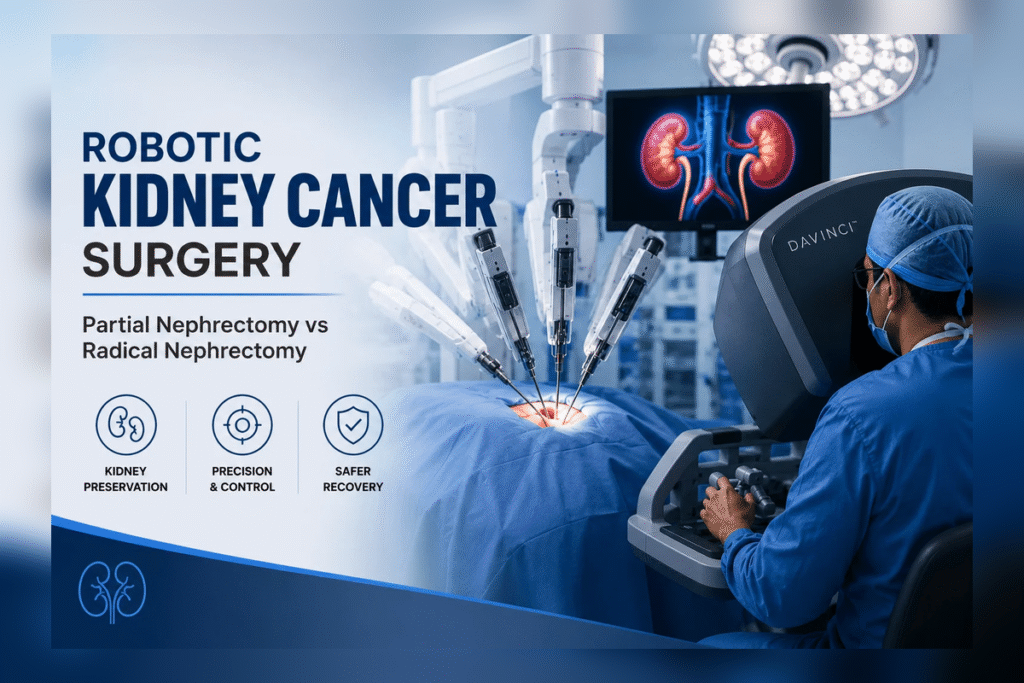
Robotic kidney cancer surgery refers to kidney cancer operations performed using a robotic-assisted surgical system.
During the procedure, the surgeon sits at a console and controls the robotic instruments. The system does not independently perform the operation. Instead, it translates the surgeon's movements into precise movements of the instruments inside the patient's body.
The robotic approach can provide:
For appropriately selected patients, robotic-assisted kidney surgery may offer the advantages associated with minimally invasive surgery, including less postoperative pain, shorter hospital stays, and faster recovery compared with open surgery.
However, robotic surgery is not automatically the best option for every kidney tumor. The surgical approach must be selected according to the patient's cancer characteristics and overall medical condition.
A partial nephrectomy is a kidney-sparing operation in which the surgeon removes the cancerous portion of the kidney while leaving as much healthy kidney tissue as possible.
The goal is to completely remove the tumor while preserving kidney function.
For selected patients with localized kidney cancer, partial nephrectomy can provide cancer-control outcomes comparable to radical nephrectomy while preserving more kidney tissue.
Kidney function is an important consideration when planning cancer surgery.
Preserving healthy kidney tissue can be particularly important for patients who:
The decision is individualized and depends on whether complete tumor removal can be achieved safely.
The procedure generally involves several stages.
Before surgery, the medical team evaluates the kidney tumor using appropriate imaging and other diagnostic information.
The surgeon considers:
This information helps determine whether partial nephrectomy is technically and medically appropriate.
Robotic surgery is performed through several small abdominal incisions.
A camera provides an enlarged view of the surgical area while robotic instruments are introduced through the other openings.
The surgeon carefully identifies the kidney tumor and the surrounding anatomy.
The enhanced visualization provided by robotic technology can assist with precise dissection around important structures.
The cancerous portion of the kidney is carefully separated from healthy kidney tissue.
The objective is to remove the tumor completely while preserving as much functioning kidney tissue as possible.
After tumor removal, the remaining kidney tissue may be repaired to control bleeding and restore the kidney's structure.
The removed tissue is sent for pathological examination.
A radical nephrectomy involves removing the entire kidney containing the cancer. Depending on the circumstances, surrounding fatty tissue, lymph nodes, or the adrenal gland may also be removed when clinically indicated.
Radical nephrectomy may be recommended when a partial nephrectomy would not provide adequate cancer control or would be technically unsuitable.
For example, a radical approach may be considered when:
The exact surgical plan depends on the tumor's characteristics.
Radical nephrectomy can be performed through open or minimally invasive approaches.
In robotic-assisted radical nephrectomy, the surgeon uses several small incisions and controls the robotic instruments from a console.
Compared with open surgery, minimally invasive approaches can offer advantages such as:
The American Cancer Society notes that laparoscopic and robotic-assisted laparoscopic nephrectomy can provide similar effectiveness to open radical nephrectomy in experienced hands, while generally offering shorter recovery and less postoperative pain.
The key difference is how much of the kidney is removed.
| Feature | Partial Nephrectomy | Radical Nephrectomy |
|---|---|---|
| Kidney removed | Part of kidney | Entire kidney |
| Main objective | Remove tumor and preserve kidney tissue | Remove kidney containing the tumor |
| Kidney preservation | Higher | Not possible on the operated side |
| Suitable for | Selected tumors | Larger or more complex tumors |
| Surgical complexity | Often more technically demanding | Depends on tumor characteristics |
| Robotic approach | Possible in selected cases | Possible in selected cases |
Partial nephrectomy is often preferred for suitable smaller tumors because preserving kidney function can be beneficial. However, radical nephrectomy remains an important treatment when tumor characteristics make kidney-sparing surgery unsuitable.
There is no single procedure that is best for every patient.
For selected early-stage tumors, partial nephrectomy can provide effective cancer treatment while preserving more kidney function. The NCI notes that appropriately selected patients can have comparable cancer outcomes with partial and radical nephrectomy.
However, radical nephrectomy may be more appropriate when the tumor is too large, centrally located, technically difficult to remove safely, or has extended beyond the kidney.
The decision should therefore be based on cancer control first, followed by consideration of kidney preservation and the patient's overall health.
A patient may be considered for robotic kidney cancer surgery when the tumor can be safely treated through a minimally invasive approach.
Important factors include:
Smaller kidney tumors are often more suitable for partial nephrectomy, although size alone does not determine whether robotic surgery is possible.
A tumor located near the kidney's central structures can be more technically challenging than one positioned toward the outer portion of the kidney.
Patients with reduced kidney function may benefit from preserving as much healthy kidney tissue as possible when technically feasible.
Multiple tumors may require a different surgical strategy.
The stage of kidney cancer plays an important role in determining whether surgery is appropriate and which operation should be performed.
Heart, lung, kidney, and other health conditions can influence whether minimally invasive surgery is appropriate.
When performed in appropriately selected patients, robotic surgery can offer several advantages.
Robotic procedures are performed through small incisions rather than the larger incision associated with traditional open surgery.
The surgeon can view the surgical area with magnification and three-dimensional visualization.
Robotic instruments provide a high degree of maneuverability, which can be particularly useful during technically demanding kidney-sparing surgery.
When partial nephrectomy is appropriate, robotic technology can assist the surgeon in removing the tumor while preserving healthy kidney tissue.
Minimally invasive kidney surgery can be associated with less postoperative pain and a shorter recovery compared with open surgery.
It is important to remember that individual recovery varies, and robotic surgery does not eliminate the risks associated with major surgery.
Recovery depends on the type and complexity of surgery.
Patients are generally encouraged to begin moving as advised by their medical team after surgery. Gradually increasing activity can support recovery.
During recovery, patients may be advised to:
The recovery timeline differs between partial and radical nephrectomy and between individual patients.
Your surgeon will provide personalized instructions based on the procedure performed and your overall health.
Like any major surgical procedure, kidney cancer surgery has potential risks.
These can include:
The American Cancer Society also identifies urine leakage after partial nephrectomy and kidney failure among possible complications.
The risk depends on the patient's health, tumor characteristics, surgical complexity, and the type of procedure performed.
The removed kidney tissue or tumor is examined by a pathologist.
The final pathology report provides important information about:
Depending on the final pathology and stage, the medical team may recommend surveillance, additional treatment, or further evaluation.
Surgery is not always the end of kidney cancer care. Long-term follow-up is important for monitoring kidney function and checking for recurrence.
Robotic technology is only one component of successful kidney cancer surgery.
The surgeon must determine:
For a patient considering robotic kidney cancer surgery in Ahmedabad, choosing a surgeon with experience in robotic cancer surgery and urologic oncology can be an important part of treatment planning.
Dr. Nitin Singhal provides advanced robotic cancer surgery in Ahmedabad, with treatment plans tailored according to the patient's cancer diagnosis, tumor characteristics, and overall health.
Robotic kidney cancer surgery is an established minimally invasive approach for appropriately selected patients. As with any surgery, it carries potential risks, and suitability depends on individual circumstances.
Neither is universally better. Partial nephrectomy can preserve more kidney tissue and is preferred when technically and oncologically appropriate. Radical nephrectomy may be necessary for larger or more complex tumors.
Yes. Selected patients can undergo robotic-assisted radical nephrectomy, in which the surgeon removes the affected kidney through a minimally invasive approach.
When a partial nephrectomy is appropriate, preserving healthy kidney tissue can help preserve kidney function compared with removing the entire kidney.
Recovery varies depending on whether a partial or radical nephrectomy was performed, the complexity of the operation, and the patient's overall health. Your surgeon will provide a personalized recovery plan.
No. Very large, centrally located, invasive, or otherwise complex tumors may require a different surgical approach. The decision is made after reviewing imaging, cancer stage, kidney function, and other factors.
Robotic kidney cancer surgery provides a minimally invasive option for appropriately selected patients with kidney tumors. Depending on the tumor's size, location, stage, and the patient's kidney function, surgery may involve robotic partial nephrectomy or robotic radical nephrectomy.
Partial nephrectomy focuses on removing the tumor while preserving healthy kidney tissue, whereas radical nephrectomy removes the entire affected kidney. Both procedures have an important role in kidney cancer treatment, and the right choice depends on achieving effective cancer control while considering long-term kidney function.
If you are looking for robotic kidney cancer surgery in Ahmedabad, a detailed consultation with an experienced cancer surgeon can help determine which surgical approach is appropriate for your specific condition.
Dr. Nitin Singhal offers advanced robotic cancer surgery and urologic oncology care in Ahmedabad, with treatment decisions based on each patient's individual diagnosis and clinical needs.


